
VoiSmart
What is a virtual assistant and how it enhances your business PBX
A virtual assistant supports human operators in managing repetitive tasks and customer care. It is capable of conversing like a human thanks to NLP and is powered by Artificial Intelligence (AI). Integrated into a telephone PBX, the AI virtual assistant transforms customer engagement into a smooth, personalised experience extending the capabilities of the traditional PBX while remaining compatible with existing infrastructure.
Let's set the record straight: the differences between chatbot, voicebot and virtual assistant
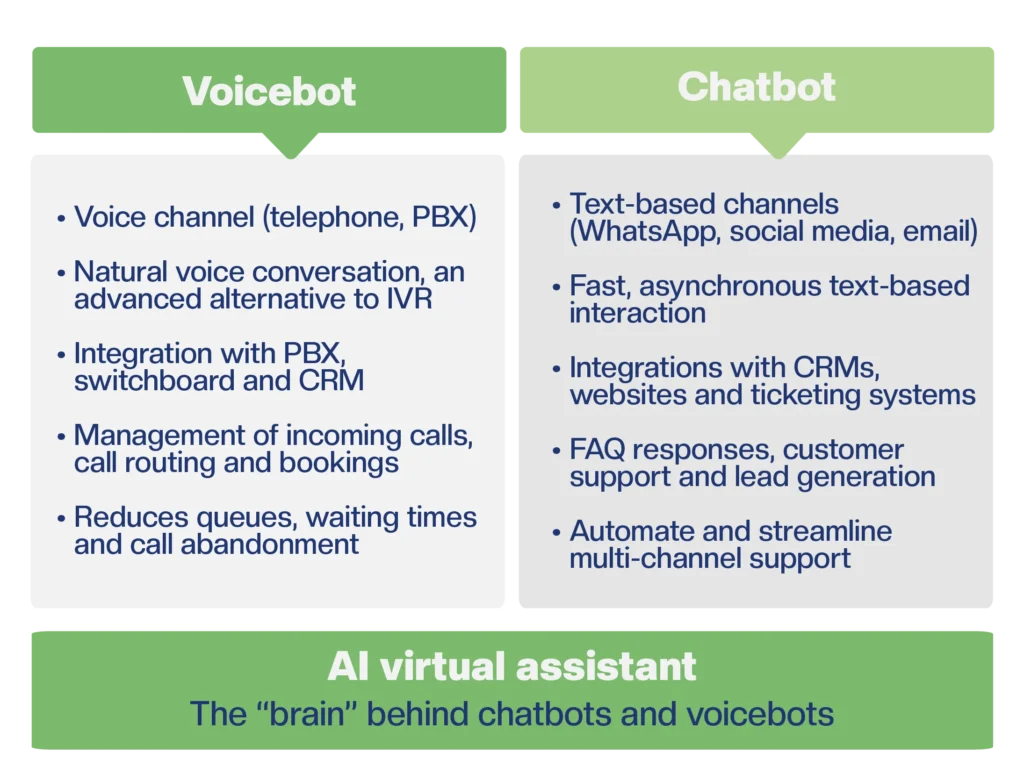
Among the new technologies transforming telecoms today are chatbots and voicebots the virtual assistants of AI conversational systems that autonomously handle both voice and text-based interactions. The market often uses these terms interchangeably, without paying attention to the practical differences between them in terms of channel type and complexity level.
The AI virtual assistant: intelligence, context and learning
The virtual assistant is an AI-powered software designed to converse like a human operator, thanks to Natural Language Processing (NLP). Its purpose is to help users by providing information, carrying out tasks and collecting data through both voice and text.
The AI virtual assistant is the "brain" behind chatbots and voicebots. Thanks to natural language understanding, it communicates with the customer, retains conversation context and improves over time. The virtual assistant learns from the documents and data loaded into the platform, finding answers and reorganising information to deliver precise responses.
Autonomously handles complex conversations
Retrieves information from documentation or websites and delivers it to the customer
Integrates with CRM/ERP to collect data and provide contextual responses
The voicebot: when the virtual assistant learns to speak
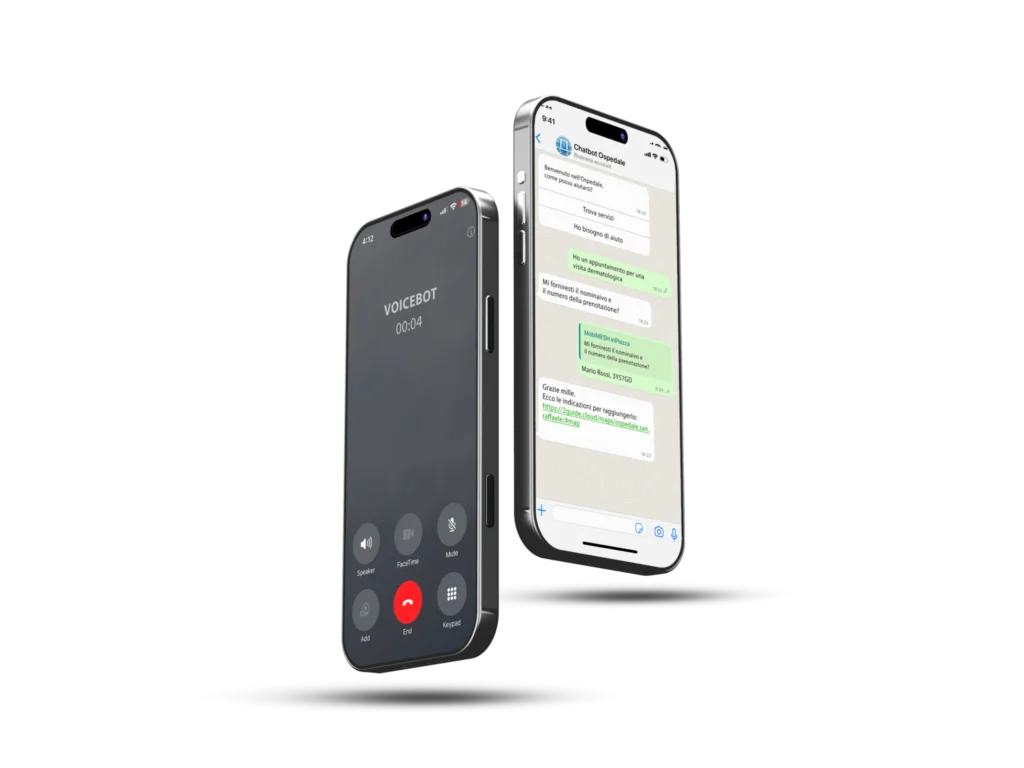
The voicebot gives voice to the virtual assistant enabling interaction on the most natural yet most complex communication channel: the phone. The voicebot integrates with the PBX and answers calls, supporting operators and receptionists in handling high volumes of incoming requests. By taking care of repetitive requests, it frees up valuable time for human operators, who can focus on higher-value activities.
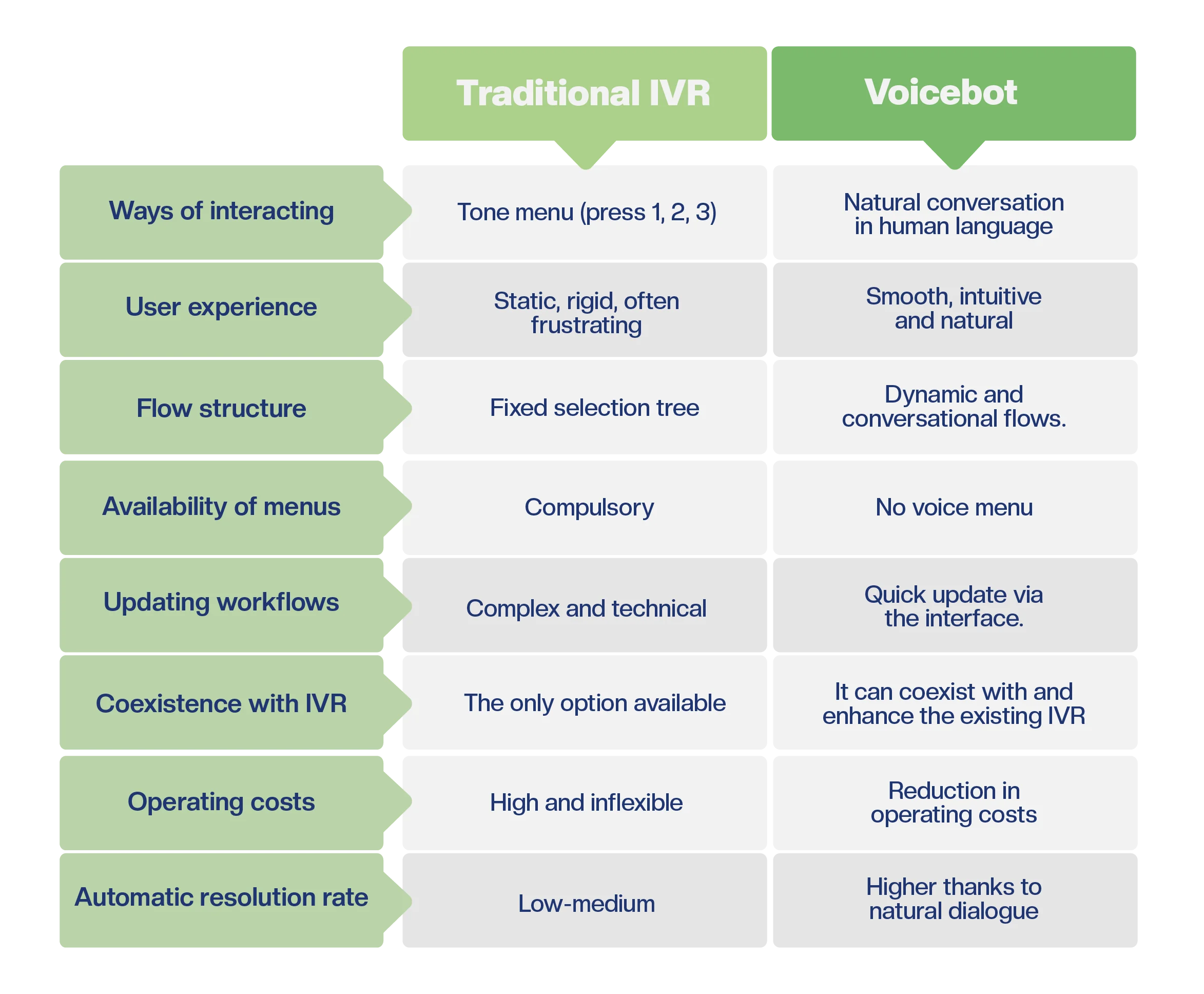
Acting as a virtual receptionist, the voicebot replaces or enhances the traditional IVR concept. Users no longer have to navigate the tedious automated response system that asks them to "press 1, press 2, press 3" instead, they simply make their request in natural spoken language. Powered by AI, it offers conversational navigation, interpreting and responding to requests and, when necessary, transferring the call to the right operator.
A point that is often misunderstood, but important to clarify: VoiSmart's OmniCloudCX AI Voicebot is not tied to the VoiSmart PBX. It is compatible with any phone system already in use in the company, from VoiSmart or other vendors, and is added as a fully-fledged extra extension, without replacing or disrupting the existing telephony infrastructure.
The voicebot interacts through spoken language and integrates seamlessly with the business PBX transforming it into an advanced automated responder capable of:
Replacing the limitations of traditional IVR systems
Supporting human operators by handling repetitive tasks
Integrating with other business tools such as CRMs
Reducing call abandonment, wait times and misdirected transfers
The chatbot: rule-based automation and scripted flows
The AI chatbot is the virtual assistant that interacts via text. It is typically used for interactions across channels such as WhatsApp, website webchat, email, Telegram, Instagram and other social platforms with the advantage of handling multiple conversations simultaneously.
Unlike the voicebot, it doesn't necessarily operate in real time (since it doesn't answer a voice call), but it has the advantage of being able to send documents, videos and links that users can consult at their own pace.
The chatbot doesn't have to rely on conversational AI it can also function as a "flow executor" based on rules, much like a telephone IVR where interaction happens via buttons or multiple-choice menus, channelling the user through a predefined flow.
Available 24/7 across multiple text-based channels
Works with automated flows
Quick to implement for FAQs and lead capture
CRM integration
What is a chatbot, in short: a chatbot is software that simulates a written conversation with the user on channels such as webchat, WhatsApp or social media. It can be based on predefined rules, such as a button-based flow that works like a text IVR, or on conversational artificial intelligence, able to understand natural language and respond autonomously by drawing on the company documentation uploaded to the platform.
The concrete advantages: how a virtual assistant transforms business
The virtual assistant offers a range of measurable benefits for businesses that adopt it in their contact centre and reception operations becoming a fundamental asset for managing many operational activities through automation and AI. The AI virtual assistant helps businesses centralise requests using intelligent, automated tools that work alongside human operators to deliver efficient customer service and fast responses 24/7.
Improving customer service: 24/7 support and immediate responses
A voicebot handles the first point of contact with users who call in 24/7 capable of responding to recurring first-level requests such as opening hours, order status and general information, reducing the workload on human operators who can then focus on more complex cases. The intelligent handoff to human staff therefore only happens when truly necessary.
The AI voicebot replaces the old traditional IVR, reducing telephone wait times and queue lengths, as well as handling call routing to direct calls to the relevant departments.
Measurable benefits of the voicebot:
Reduced wait times and telephone queues
Efficient SLA management (guaranteed response times)
Improved NPS/CX through immediate interactions
Automated, real-time call routing
Generating new leads automatically
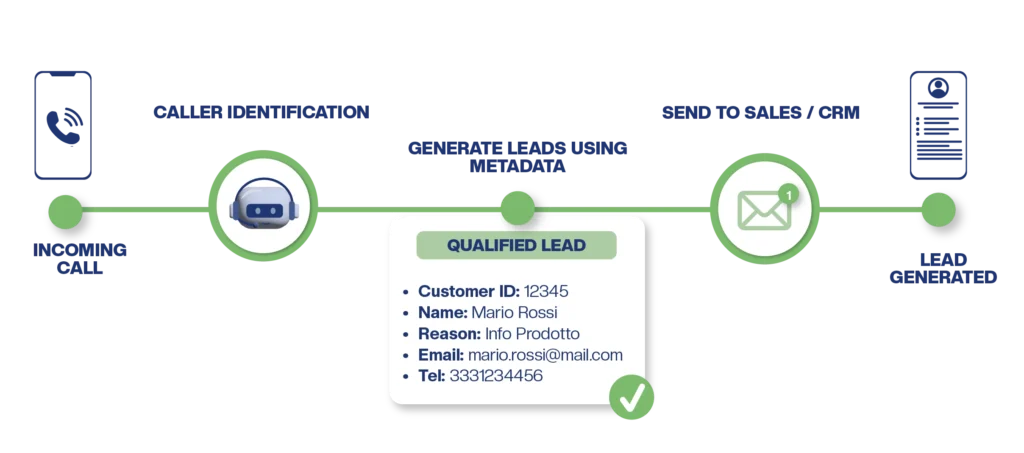
AI virtual assistants both chatbots and voicebots become powerful tools for qualifying website visitors or callers, collecting their essential data and creating leads that are sent directly to the CRM. This is also a key tool for the sales team, which receives warm leads directly from inbound calls managed by the voicebot which has already made first contact and gathered valuable needs and information.
Personalising the interface and managing the tool independently
VoiSmart's OmniCloudCX platform for managing the AI virtual assistant stands out from other solutions for its ease of use, management autonomy and the ability to customise it to your specific needs.
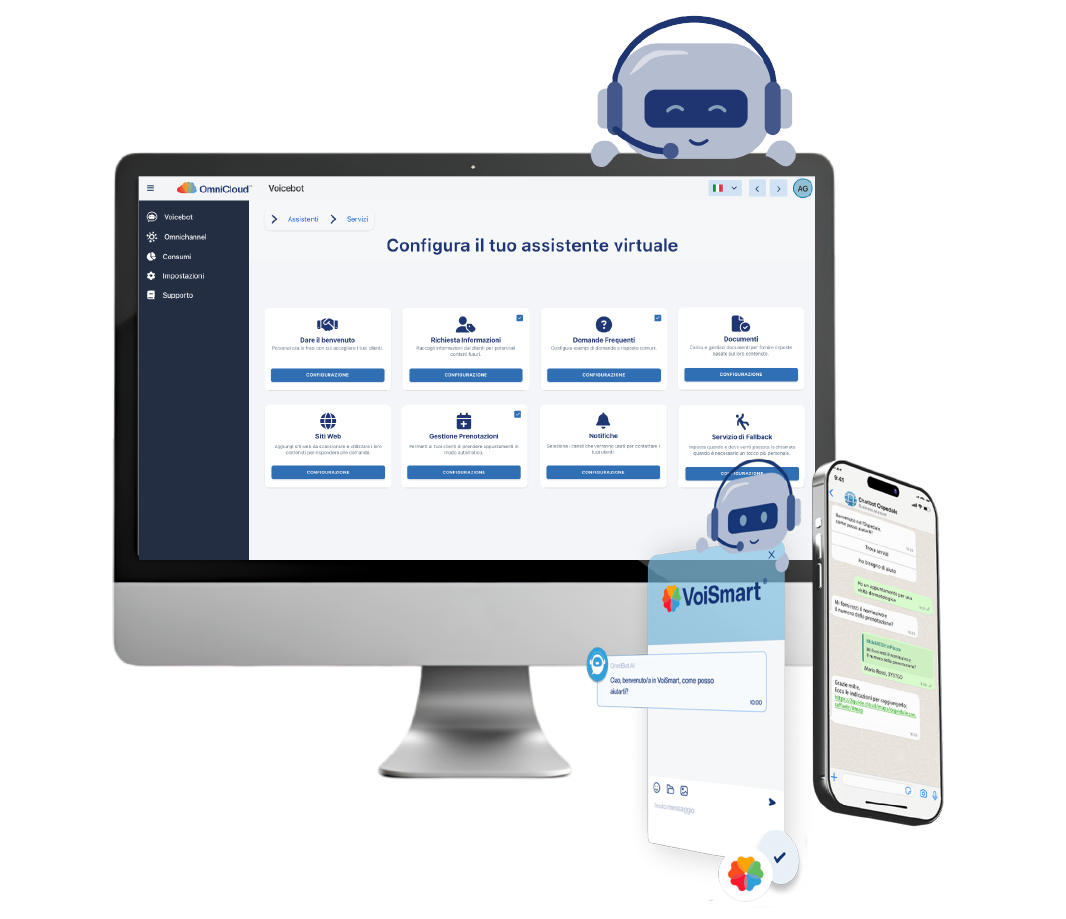
Both voicebot and chatbot can be tailored to match your brand identity with distinctive logos and colours, personalised messages, conversational scripts and KPI control dashboards. Intuitive interfaces simplify the configuration of virtual assistants, which can be managed entirely independently. For the chatbot, automated flows can be created in a single click, and the webchat widget is fully customisable and can be embedded on your website without the need for complex development work.
For the voicebot, users can configure all services from a convenient, straightforward management panel setting welcome messages, uploading documentation for the voicebot to draw from, and more.
The simplicity of the OmniCloudCX platform dramatically reduces staff training time and costs, allowing businesses to implement a tool that is intuitive for all employees.
Advantages:
Full autonomy in platform personalisation
Fast updates to automated flows
Ease of use and complete platform control by the business
Integration with the PBX: the true enhancement of your phone system
AI is not an island it becomes a plugin that makes existing telephony intelligent. Integrating an AI virtual assistant with the PBX transforming the traditional IVR means enhancing the phone system with an AI-based voicebot that autonomously handles interactions in natural language. VoiSmart guides businesses through the transition from traditional IVR to AI voicebot integration within the PBX (cloud or on-premise), without disrupting the existing infrastructure.
This also applies when the PBX isn't from VoiSmart: a voicebot designed for telephony connects to any SIP phone system as an extra extension, turning a traditional PBX into an AI-powered phone system without changing PBX. We explain how it works in detail on the OmniCloudCX AI Voicebot page.
In this way, the user experience is significantly transformed moving from: "Please press 1 for sales, press 2 for accounts" to a virtual receptionist powered by a voicebot that manages the conversation autonomously: "Hi, tell me what you need and I'll help you."
Managing telephone queues intelligently
The voicebot, rather than routing calls through a classic IVR menu, responds immediately by seeking to understand the caller's intent and needs such as "I'd like to speak to accounts" or "I have a technical issue" then routes the call to the correct extension or answers FAQs where possible.
The AI virtual assistant's handling of the PBX significantly reduces missed calls, call abandonment and misdirected transfers eliminating the rigid menus typical of traditional IVR systems.
Qualifying inbound calls before passing them to an operator
During first contact with the caller, the voicebot asks the preliminary questions needed to gather useful information (customer code, issue description, contact details) and passes these to the human operator optimising their valuable time. This allows for an initial triage that reduces repetitive calls for frequently asked questions that a voicebot can handle, and ensures that high-value calls are routed to the right department with a set of useful contextual details already in hand.
From traditional IVR to voicebot: transforming the automated responder
The traditional IVR (Interactive Voice Response) is a technology used in contact centres to automate customer interactions. IVR manages calls through tone-based menus and rigid decision trees to route calls to the right department but often delivers a frustrating experience.
VoiSmart offers an innovative solution that transforms the existing IVR into an AI voicebot without overhauling the entire existing telephone infrastructure. Compared to a classic IVR, the voicebot brings significant advantages to the contact centre: fewer abandoned calls, a more natural experience, and the ability to update flows through simple configuration no need to rewrite scripts and menu trees every time.
How to implement a virtual assistant: the practical guide
Implementing a virtual assistant is a structured yet pragmatic project. Doubts about the implementation process can hold projects back which is why it's important to understand the typical phases and how VoiSmart guides businesses through them.
Is it easy to install? Technical requirements and support
Choosing VoiSmart as your partner helps reduce all installation and delivery complexity. VoiSmart provides an end-to-end solution and direct support assessment, integration and training making implementation a guided process rather than a leap in the dark.
If the customer already has a PBX and wishes to keep their existing system, it is possible to add only the AI component as an intelligence layer.
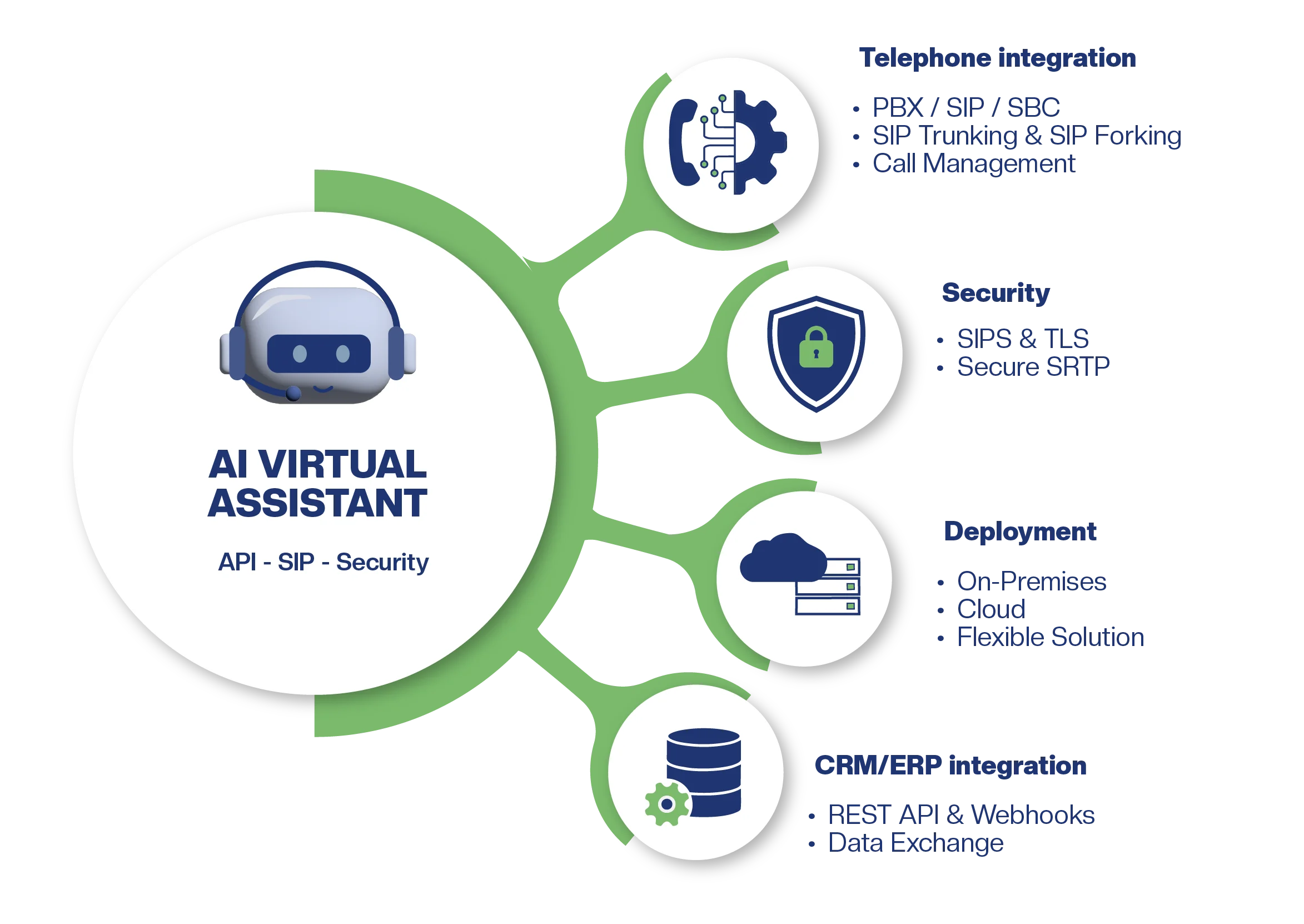
How to configure an AI virtual assistant
The fundamental phase of any AI virtual assistant implementation project is the configuration of conversation flows. Voicebot training is based on data drawn from specific documentation (FAQs, website URLs, manuals, etc.) uploaded by the customer. The flow guides the agent in performing actions ranging from interacting with external services and providing user support, to collecting data and transmitting it to the company CRM.
Selection criteria: what to evaluate before deciding
To choose an AI virtual assistant provider, an IT manager or anyone looking for this type of solution to improve their contact centre and support operations must compare providers against a series of fundamental criteria.
The virtual assistant can start with just a few flows managing only FAQ responses and appointment booking and scale up to handle thousands of calls per day, new departments and new use cases, all without changing platform.
Scalability, customisation and ease of management
The virtual assistant whether voicebot or chatbot integrated into the PBX must be scalable, growing with the business from a handful of flows and calls up to thousands of interactions. It must therefore be a solution suitable for any company size.
Control and ease of platform management are essential for customising the contact centre service to match specific business needs.
Data security and compliance (GDPR and AI Act)
Security is a crucial consideration when handling customer and user data. When choosing a provider, it's worth checking three things: GDPR compliance, how the system is classified under the AI Act (a customer service virtual assistant usually falls into the limited-risk category, which requires transparency towards the people talking to the AI) and where conversation data is stored. VoiSmart's OmniCloudCX virtual assistant meets all three requirements and is designed for European data sovereignty: you'll find the details on the Privacy & security page.
Calculating the return on investment (ROI)
Investing in an AI virtual assistant solution requires calculating the expected return on investment. There are a number of success metrics to measure when implementing a chatbot and voicebot service:
Time saved by operators on repetitive tasks
Average speed of answer (ASA) before/after
Percentage of calls handled automatically (Automation Rate)
Number of appointments/leads generated automatically
Reduction in queue wait times and IVR management costs
The PBX that becomes intelligent
Integrating a virtual assistant in particular a voicebot into the business PBX transforms it from a routing tool into an intelligent customer service platform: fewer queues, more leads, more productive operators and a better experience for the end user.
Want to assess whether a voicebot is the right solution for your infrastructure? Contact VoiSmart for a free technical assessment: we'll map your IVR flows, estimate potential ROI and present a tailored implementation roadmap.
Still have questions?
If you haven’t found the answer you were looking for here, our team is at your disposal. Get in touch for more information or personalised support we’ll be happy to clear up any doubts.
We’ve compiled answers to our users’ most common questions.
Frequently asked questions (FAQ) about virtual assistants
What is the difference between a chatbot and ChatGPT?
ChatGPT is a general-purpose language model. A business virtual assistant, on the other hand, is specialised and trained on the company’s own data and documentation providing relevant, controlled responses that are compliant with company policies.
Can a virtual assistant completely replace a human operator?
No. An AI virtual assistant is designed as an enhancement to reception and human operator teams. It handles repetitive, first-level tasks freeing up human colleagues to spend more time on higher-value cases.
How much does it cost to implement a virtual assistant?
The cost of a virtual assistant depends on the complexity of the flows and integrations involved. It is typically evaluated as an investment with measurable KPIs: reduced wait times, automation rates, leads generated. VoiSmart offers transparent pricing models that adapt to the specific use case unlike many providers who charge based on minutes or tokens.
Can I replace my traditional IVR with an AI voicebot?
Yes. With VoiSmart, the transition from IVR to voicebot is straightforward: critical flows can be migrated one at a time, the voicebot can be tested in parallel, and the traditional IVR can then be decommissioned. Compatibility with an existing PBX is guaranteed the AI behaves as a layer that manages calls and routing in natural language. The voicebot is able to transfer calls to queues based on user needs, obtain information about user availability and relay it to the caller.
How complex is virtual assistant training?
Training or configuring an OmniCloudCX AI voicebot or chatbot is straightforward and requires data provided by the company (FAQs, documentation, website links, scripts, recordings). The virtual assistant platform provides tools that allow flows to be updated independently, giving the business full control over the solution.
What is a phone virtual assistant?
A phone virtual assistant is an AI voicebot connected to the company PBX that answers calls in natural language, instead of or alongside the receptionist: it handles requests, call routing and bookings without the classic touch-tone IVR.
Does the voicebot work if my PBX isn ‘t from VoiSmart?
Yes. The OmniCloudCX Voicebot connects to existing SIP phone systems, from VoiSmart or other vendors, and is added as a dedicated extension, without requiring you to replace the PBX already in use.
VoiSmart is proudly powered by WordPress
Talk to our experts
This form is intended solely for commercial enquiries, partnership requests and general enquiries. For technical support, please contact your service partner or the dedicated support channel.
Parla con un nostro esperto
Questo modulo è dedicato esclusivamente a richieste commerciali, partnership e informazioni. Per assistenza tecnica, contatta il tuo partner di assistenza o il canale di supporto dedicato.