
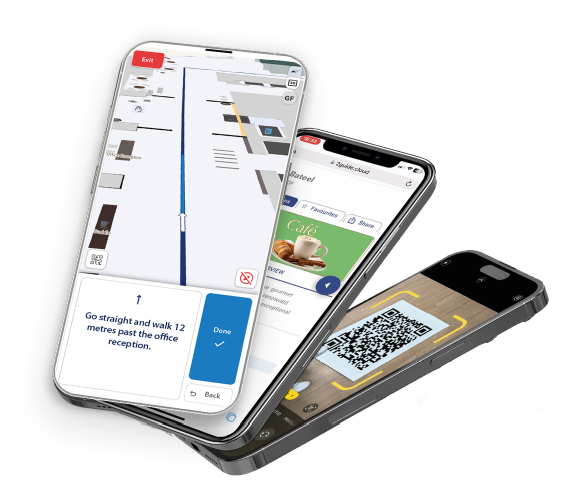
Indoor navigation: the guide to QR code technology no app, no infrastructure
Indoor navigation has become a strategic asset for any large, complex space where finding your way is not straightforward: airports, hospitals, shopping centres, trade fairs, museums and large public buildings. With 2Guide, VoiSmart offers an evolved approach to indoor navigation, based on QR codes and completely app-free and infrastructure-free, that simplifies the end-user experience and dramatically reduces complexity and costs for those managing the facility.
2Guide is, in every respect, an indoor wayfinding and location system: it helps people find their way (wayfinding) and lets them know exactly where they are (indoor location) within a complex space, without the costly infrastructure required by traditional IPS systems.
What indoor navigation is for: the advantages for complex spaces
Indoor navigation removes friction from the visitor journey in large environments and transforms the space map into an operational and commercial channel.
In complex spaces, shopping centres, hospitals, airports, trade fairs, etc. finding your way is often the most frustrating part of the experience. The concrete problems that indoor navigation solves are clear:
Disoriented visitors
who waste time and experience frustration, with a negative impact on the overall experience.
Staff overloaded
with requests for directions, pulled away from higher-value activities.
Retail units or services that are poorly visible
and difficult to promote in a contextual way.
With the VoiSmart 2Guide indoor navigation solution, these challenges in large spaces become opportunities: it increases visitor autonomy (less stress, better punctuality), optimises internal resources (fewer “manual” support requests) and transforms maps into a new communication channel with branded points of interest, in-map promotions and contextual calls-to-action that generate footfall and conversions.
2Guide, the VoiSmart indoor navigation solution, turns the traditional model on its head: rather than building costly position-detection infrastructure, it offers QR code-based indoor navigation, with no app to download and no significant hardware investment. Scan, choose your destination and go. It’s the simple, immediate and reliable indoor navigation solution.
The smart alternative : how indoor navigation with QR codes works
When talking about indoor navigation, the first question shouldn't be "which technology to use", but how easy it is to get people to actually adopt it. This is where the VoiSmart 2Guide solution stands out and becomes the smarter choice compared to traditional systems based on complex infrastructure.
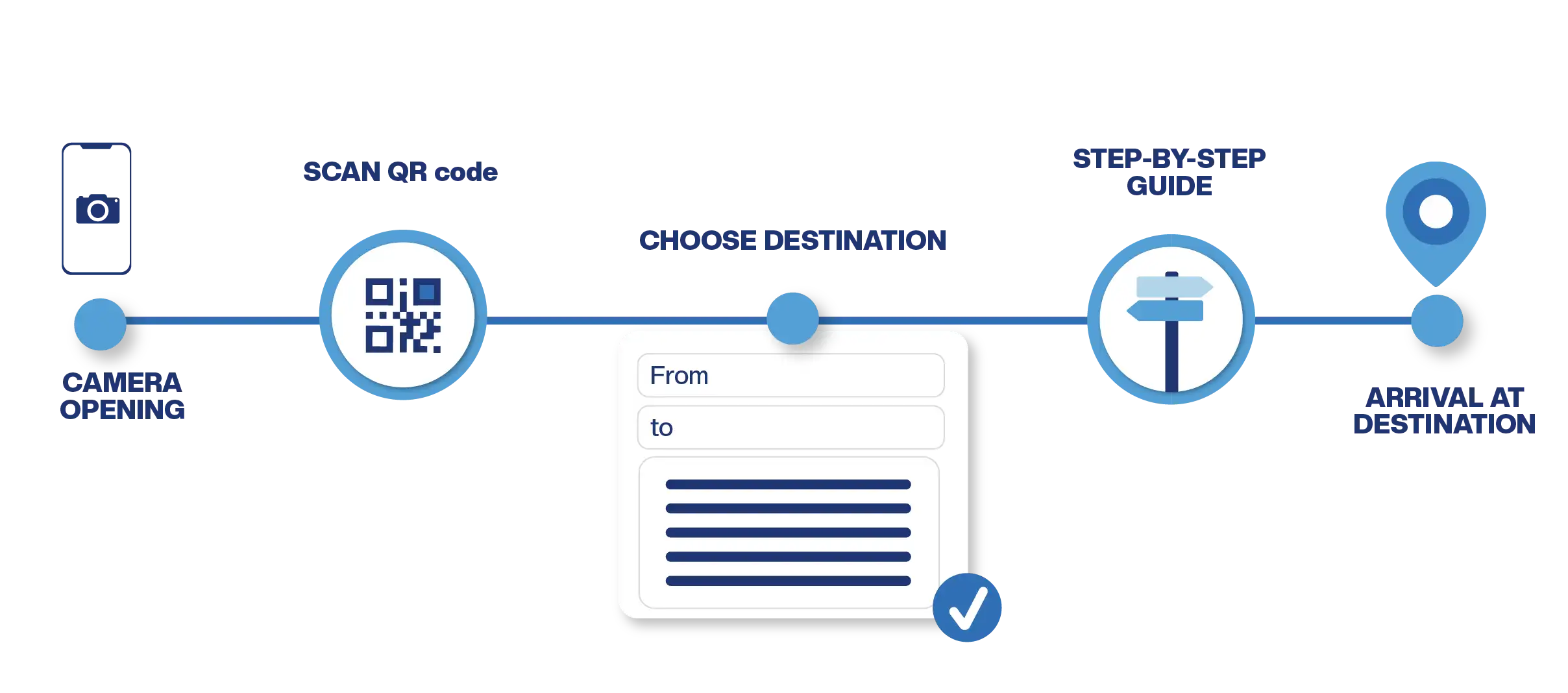
QR code indoor navigation removes all friction both for those managing the space and for those navigating it. The process is immediate and intuitive: the user scans a QR code, chooses their destination and is guided step by step through the facility, directly from their smartphone browser. No app to install, no configuration, no barriers to use.
The QR code acts as an indoor navigation system that identifies exactly where the user is, at the point of the scan. The 2Guide QR code navigation proceeds step by step along the map, and if the user gets lost along the way, they can scan a nearby QR code to re-establish their position on the map.
This approach makes 2Guide the ideal solution for high-traffic environments such as hospitals, shopping centres, trade fairs, airports and large buildings, where simplicity, reliability and speed of access are decisive factors.
Why an "infrastructure-free" and "app-free" approach
From a technological and operational standpoint, the VoiSmart indoor navigation solution adopts an infrastructure-free model that requires no installation of beacons, sensors or dedicated hardware. This translates into concrete, immediately tangible advantages especially for IT and operations managers.
The absence of hardware eliminates upfront capital expenditure (CAPEX) and dramatically reduces ongoing operational costs (OPEX): there are no devices to power, maintain or replace over time. Management also becomes simpler, since the entire system is centralised and updatable from a single back-office interface.
At the same time, the app-free approach removes one of the main barriers to adoption of traditional indoor navigation solutions. Users don't need to download anything, don't need to register and don't need to worry about device compatibility. All that's needed is a smartphone camera and a browser, a condition that guarantees significantly higher real-world usage rates compared to solutions based on proprietary apps.
The different types of QR code and how they are used
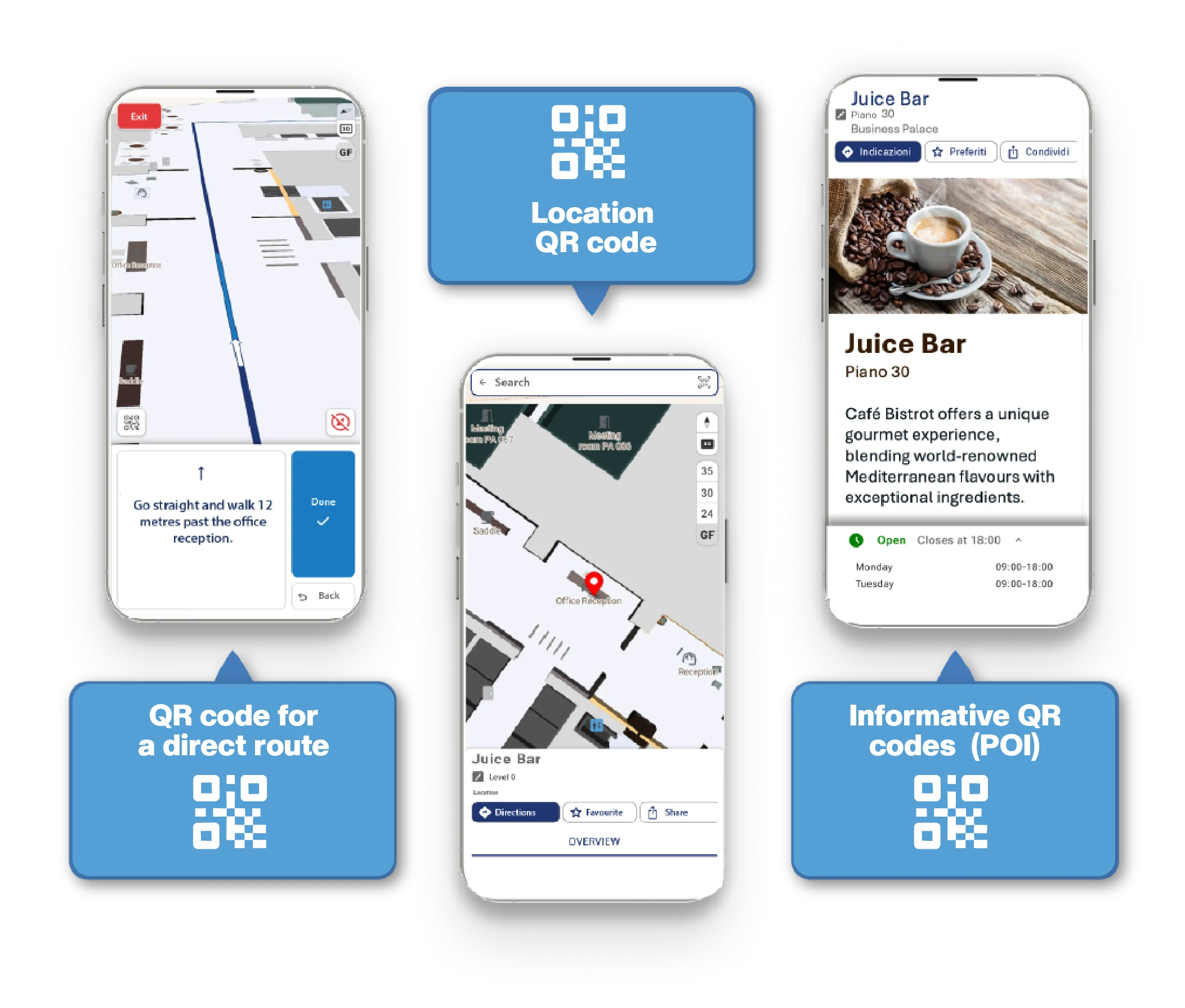
The precision and effectiveness of VoiSmart's 2Guide solution stem from the intelligent use of different types of QR code, each designed to meet specific wayfinding and information needs within a space.
Direct route QR codes
These initiate a predefined navigation immediately. They are ideal, for example, at the entrance to a facility or at strategic points such as reception desks and information points: a single scan can guide the user from check-in to a hospital department, a trade fair stand or a shop within a shopping centre with no additional steps required.
Positioning QR codes
These serve to precisely locate the user at their exact current position. This allows the route to be recalculated in the event of a detour, or navigation to be resumed after a pause ensuring reliable guidance even in complex, multi-level environments.
Informational QR codes (Points of Interest)
These enrich the navigation experience with contextual content. By scanning them, the user accesses a dedicated information card for a service or business: description, opening hours, contacts, useful links and promotions. In this way, indoor navigation also becomes a tool for communication and space promotion.
The advanced features of a modern navigation platform
The 2Guide indoor navigation solution goes beyond simply indicating a route it is a complete platform that transforms the digital map into a genuine tool for exploring physical spaces. Its advanced features allow navigation to be adapted to different contexts and address both operational needs and communication and marketing objectives.
Among the key features offered by the VoiSmart 2Guide indoor navigation solution:
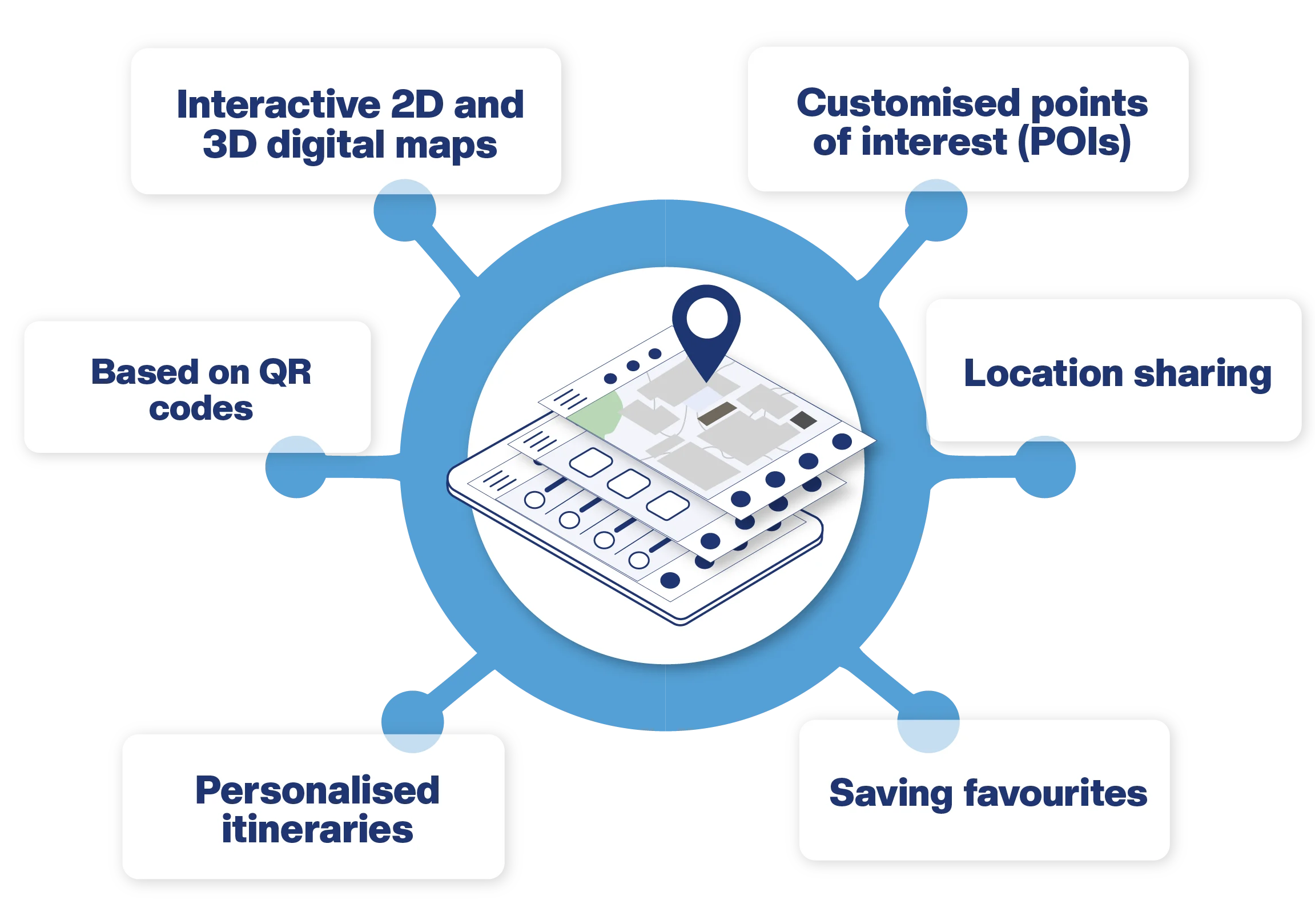
Interactive 2D and 3D digital maps
Designed to clearly represent complex spaces, multiple floors and different functional areas.
Customisable Points of Interest (POI)
With cards enriched with logo, description, opening hours, external links and promotional content.
Customised routes
Taking into account specific needs such as accessibility or the shortest path.
Location sharing and favourites saving
For example, to remember where you parked or share a meeting point with other users.
Thanks to these features, VoiSmart’s 2Guide is positioned as an advanced indoor navigation solution, capable of improving the visitor experience, optimising space management and creating new opportunities for interaction and value for the organisations that adopt it.
Traditional technologies compared: beacons, Wi-Fi and QR codes
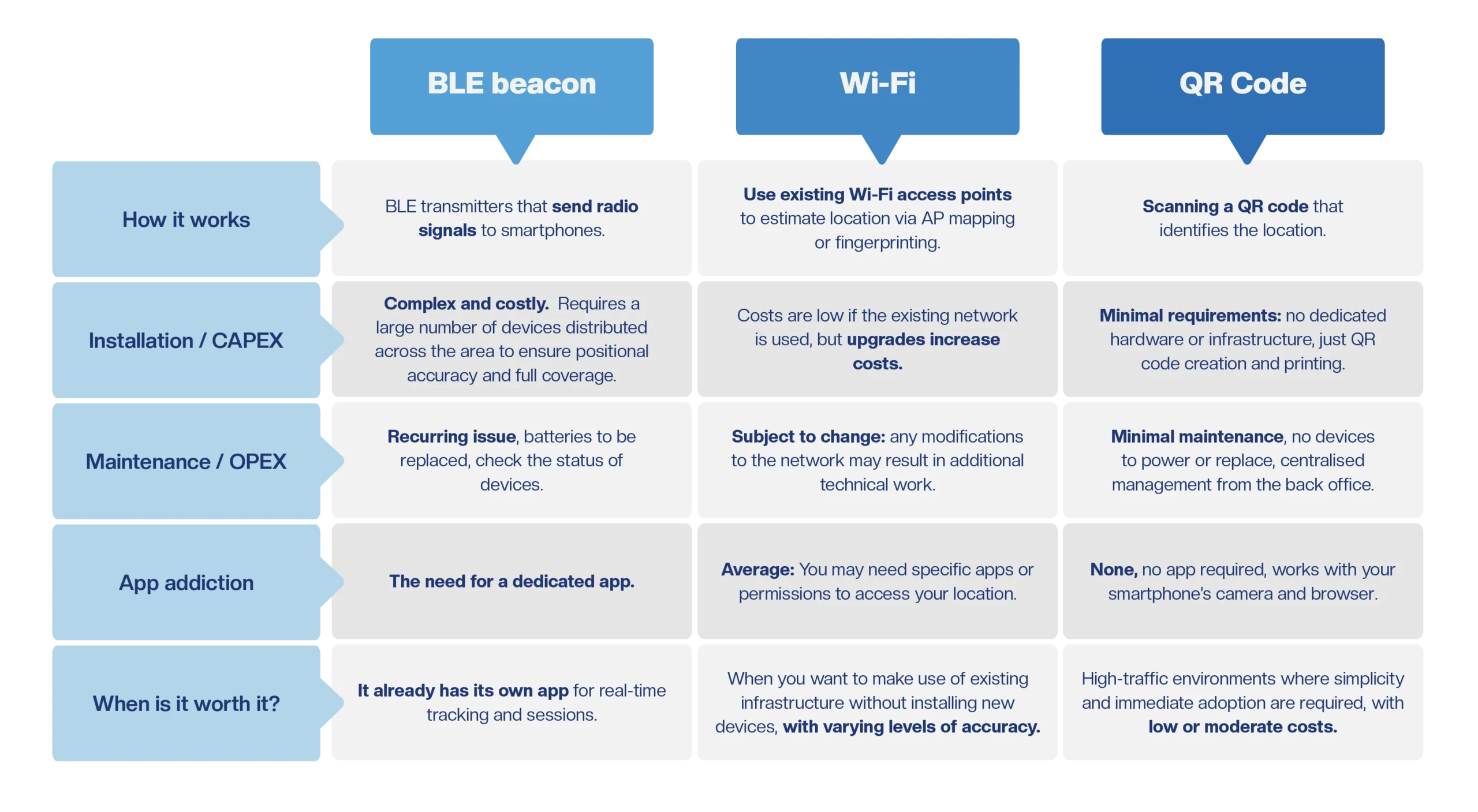
In the world of indoor navigation, several technologies exist. BLE beacons, Wi-Fi positioning and QR code-based systems respond to different needs in terms of precision, cost, infrastructure and user experience.
Understanding the differences is essential to choosing an indoor navigation solution that is genuinely sustainable over time.
Having explained why a QR code-based approach is often the most practical and scalable choice for indoor navigation, it is worth briefly comparing the "traditional" alternatives. This helps to understand not only what works, but why 2Guide stands out as the preferable solution in many contexts.
Beacon technology (BLE): limitations and management costs
BLE beacons are small transmitters that emit radio signals, used by an IPS (Indoor Positioning System) to estimate the position of a smartphone. Beacons allow continuous, user-free localisation, but in practice they come with significant limitations:
Installation and CAPEX
Achieving consistent coverage requires numerous devices distributed throughout the space, with considerable upfront costs.
Maintenance (OPEX)
Beacons are battery-powered, in large installations, replacement and status checks become recurring and costly operations.
App dependency
Most beacon solutions require the installation of a dedicated app to interpret the signals, reducing real-world adoption rates among users.
Variable accuracy
Physical obstacles, interference and beacon placement can all compromise accuracy, requiring periodic recalibration.
For these reasons, beacons are a sensible choice only when continuous positioning is genuinely required, with dedicated investment and maintenance.
Wi-Fi based technology: pros and cons
Wi-Fi indoor navigation uses the access points already present in the building to estimate the user's position via triangulation. Leveraging the existing Wi-Fi infrastructure for positioning may seem cost-effective, it requires no additional devices and can use AP mapping to estimate position, however:
Accuracy is often variable and depends on the density and placement of access points; in complex environments, it may prove insufficient for reliably guiding someone from one point to another.
Improving accuracy frequently requires network upgrades, recalibration and fingerprinting tools, with hidden costs.
The user experience, as with beacons, may require apps or specific permissions, complicating adoption.
In short, Wi-Fi positioning is useful for large-scale analytics, but is less suited when precise, immediate, low-complexity navigation is needed.
QR codes: nsimple, scalable, app-free indoor navigation
The QR code-based approach adopted by 2Guide reverses the logic of traditional IPS systems. It requires no active hardware, batteries or radio calibration. The user's position is determined by scanning QR codes strategically placed throughout the space. Everything happens via browser, no app download required.
This model eliminates the main pain points of traditional solutions:
No active hardware to install or maintain
Reduced implementation costs
Immediate adoption, no app required
Centralised map updating
The VoiSmart QR code indoor navigation technology represents a simple, scalable and low-infrastructure-impact solution compared to traditional IPS systems. It is the right choice when the goal is to implement an effective wayfinding system that is easy to manage and quickly adopted by users. The VoiSmart 2Guide indoor navigation is particularly well suited to dynamic or high-traffic environments, such as hospitals, shopping centres, airports and trade fairs, where frequent map updates and operational simplicity are key. It is a strategic choice when the objective is to combine precision, sustainability and centralised platform control, while keeping project complexity low.
Beyond the map: integration with artificial intelligence
The VoiSmart 2Guide is not just indoor navigation, it is a platform designed to connect physical location with advanced digital services. By integrating indoor navigation with conversational agents and AI, it becomes possible to offer genuinely contextual assisted navigation.
A practical example: the user scans a QR code near a point of interest and, in addition to receiving step-by-step guidance, can start a conversation on WhatsApp or webchat with a virtual assistant that provides additional information, bookings or geolocated coupons. The combination of location and conversation creates phygital scenarios: multilingual support, dynamic FAQs, personalised promotional messages and useful data collection for CRM purposes.
This integration transforms the digital map into a service and monetisation channel, with a frictionless user experience (no app) and a strong impact on conversion rates.
Guiding people, simplifying spaces
Adopting an indoor navigation solution doesn't just mean providing directions, it means making spaces more comprehensible, accessible and efficient, without introducing unnecessary technological complexity. Choosing the right approach means investing in a flexible, sustainable solution that is ready to evolve over time. Want to discover VoiSmart's 2Guide indoor navigation up close?
Still have questions?
If you haven’t found the answer you were looking for here, our team is at your disposal. Get in touch for more information or personalised support, we’ll be happy to clear up any doubts.
We’ve compiled answers to our users’ most common questions.
Frequently asked questions (FAQ) on indoor navigation
How accurate is a QR code-based system?
Accuracy is absolute at the point of scanning, the QR code identifies exactly where the user is located.
How are map updates managed?
Changes to dynamic content (opening hours, promotions, POI descriptions) are updated immediately from the back-office panel. If the physical layout changes (redesign, new walls), a new base map needs to be uploaded, the operation is centralised and manageable by the team responsible for the space.
Is it difficult to install and maintain?
No. A typical installation involves uploading floor plans and printing/placing QR codes at key points. Routine maintenance consists of updating content and maps from the back-office. This is infinitely simpler and less expensive than managing beacon networks (batteries, replacements, calibration).
Does it work with any smartphone?
Yes. All you need is a camera and a modern browser: the VoiSmart indoor navigation solution is app-free and compatible with major operating systems (iOS, Android). This reduces the barrier to adoption and increases actual usage rates.
What is the difference between indoor navigation and wayfinding?
In practice, these terms overlap: wayfinding refers to the set of tools, signage, maps, and directions that help people find their way within a space, while indoor navigation is its digital, step-by-step guided version. The VoiSmart 2Guide digitizes traditional wayfinding with QR code-based indoor navigation, requiring neither an app nor dedicated infrastructure.