From Chaos to Smart Wayfinding: How Customer Experience Is Changing in Physical Spaces
Every day, millions of people walk into shopping malls, hospitals, university campuses, and airports without knowing exactly where to go. Queues, disorientation, and a constant stream of requests for directions aren’t just minor inconveniences: they represent hidden costs, stress for both visitors and staff, and a fragmented customer experience. Having already transformed communication and customer service, technology — powered by digital transformation — is now turning its attention to smart wayfinding through indoor navigation in physical spaces: a new, simple, and immediate way of moving around and interacting within complex environments.
Why Indoor Navigation Is Key to Reducing Stress and Improving Flow
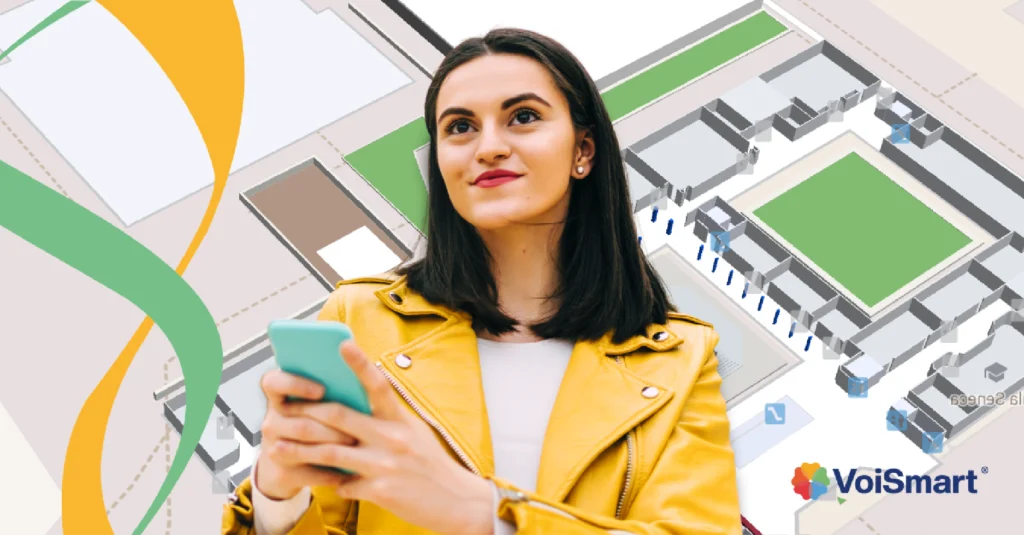
Indoor navigation in physical spaces lets visitors and users find their way independently, with clear, real-time routes, right from their own smartphone.
For those managing large spaces, this means fewer requests at information desks and to staff, fewer missed appointments, and smoother flow of people.
In a hospital, patients find their department without having to ask medical staff; in a shopping mall, visitors quickly find what they’re looking for and discover new stores along the way; at an airport, passengers move more efficiently, improving flight punctuality and the overall experience. The effect is twofold: less stress for the user, more efficiency for the organization.
Where It’s Used: Key Use Cases in Italy
- Shopping malls: to help visitors navigate between floors and areas, and to promote stores and services through interactive maps and sponsored points of interest.
- Hospitals and healthcare facilities: to reduce requests at reception desks, improve punctuality for appointments, and enhance the patient experience.
- Airports and train stations: to manage flows, deliver dynamic communications about gates and services, and reduce queues.
- Universities and campuses: to help students and visitors find classrooms, offices, and points of interest.
In all of these contexts, indoor navigation isn’t just a useful service — it’s a strategic factor for competitiveness and innovation.
Benefits for Space Managers: Efficiency, Data, and New Business Opportunities
For facility managers, implementing an indoor navigation solution for physical spaces delivers tangible, measurable benefits:
- Lower operational costs: fewer direct requests and less dedicated support staff needed.
- Improved user experience: more satisfied visitors, more loyalty, and more repeat visits.
- Digital monetization: advertising space on interactive maps, promoting stores, events, or offers directly along the visitor’s route.
- Behavioral data and analytics: understanding how people move, to optimize routes, layouts, and services.
Indoor navigation in physical spaces, in short, becomes a communication and marketing channel, as well as a smart space-management tool.
2Guide: the italian solution for intuitive, barrier-free indoor navigation
2Guide, the indoor navigation solution developed by VoiSmart and inPiazza, transforms the experience of physical spaces in a way that’s simple, accessible, and immediate.
Simply scan a QR code to get a personalized, interactive 3D map on your smartphone, featuring:
- Dynamic routes updated in real time
- Branded points of interest (stores, departments, services)
- Integrable advertising and promotional space
- Integration with an AI chatbot to answer questions and guide users step by step
2Guide is a frictionless indoor navigation solution that takes the user experience to a new level of simplicity and accessibility.
It requires no app downloads or complex installations: it’s zero app, zero barriers, zero friction.
A lightweight, scalable platform that’s quick to deploy, perfect for shopping malls, hospitals, airports, and smart buildings looking to offer an innovative digital service with a measurable return.
But 2Guide is much more than a wayfinding tool: it’s a new channel for communication and commercial value. Digital maps become genuine interactive spaces where every point of interest can be customized with logos, information cards, advertising banners, and links for more details.
This way, visitors don’t just easily find their destination — they also discover new stores, offers, and services along the way, turning navigation into an experience of discovery and engagement.
Thanks to customized categorization of points of interest, managers of facilities like shopping malls and airports can guide traffic toward strategic areas, optimizing the visitor experience and increasing conversion and sales opportunities.
The experience is further enhanced by integration with VoiSmart’s AI ChatBot: a conversational virtual assistant that interacts with users in natural language, providing real-time support and information on WhatsApp.
Users can simply ask, for example, “Where is store X?” or “How do I get to the radiology department?” and receive an immediate, guided answer through the interactive 2Guide map.
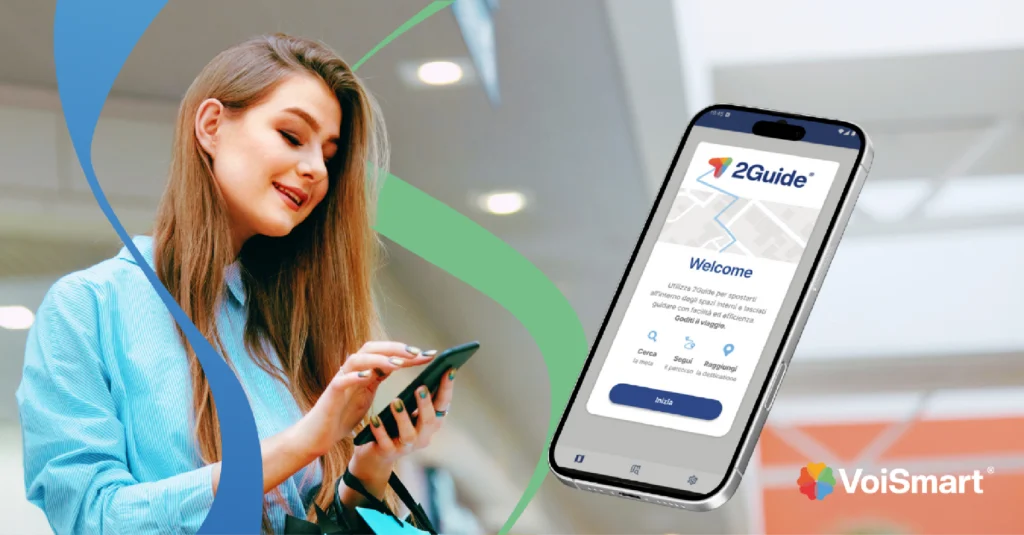
In short, 2Guide combines technology, simplicity, and value: it guides visitors, cuts operational costs, and opens up new monetization opportunities for those managing the spaces.
A smart solution that improves today’s experience while preparing for the future of connected places.
How does 2Guide indoor navigation work?
2Guide is simple and just a click away for visitors who need to find their way around large spaces:
- Scan the QR code at the entrance: the QR code pinpoints the user’s exact location.
- Find your point of interest: once the 2Guide web-based platform is open, users can select the point of interest they want to reach and start navigation.
- Position updates: these happen thanks to the device’s accelerometer and compass, along with collaborative updates from scanning the available QR codes.
The future is smart and it starts with wayfinding
Indoor navigation is much more than a map: it’s a strategic touchpoint in the relationship between brands, spaces, and people. In a world where user experience is the new competitive edge, knowing how to guide people — in the broadest sense of the word — also means driving digital transformation.
Discover how 2Guide is already bringing indoor navigation to Italian spaces