
Having a WhatsApp profile, a phone number, an email inbox, and a social media page doesn’t mean you’re managing communication in an omnichannel way. If those channels don’t talk to each other, the result isn’t omnichannel, it’s a set of communication silos that multiply the work instead of reducing it. Customers notice right away, because they’re forced to repeat the same information at every contact; operators pay for it every day, jumping from one application to another to reconstruct context that should already be available. This guide isn’t about the theoretical definition of omnichannel, but about the concrete problem of silos: how, in practical terms, do you unify ticketing, chat, voice, and social into a single flow? From VoiSmart’s experience developing business communication solutions, a few recurring principles emerge, useful for telling real integration apart from a simple juxtaposition of channels.
What omnichannel really means (and why having more channels isn't enough)
Omnichannel doesn’t mean “being present on lots of channels.” That’s multichannel, and it’s precisely what creates silos. Omnichannel is a level above that: the channels still exist, but they share the same history, the same queues, and the same metrics. For the customer, the result is the perception of dealing with a single point of contact; for the operator, working on a single flow instead of four disconnected systems.
The social channel follows its own logic: in practice, it’s more an information and marketing channel than a support one, rarely does someone with a problem open a support request through social media, but the presence still matters, and those conversations need to flow into the same place too.
What's the difference between multichannel and omnichannel?
The difference isn’t in the number of channels, but in the consistency of the experience. One example that illustrates the point: a customer sends an email about a non-urgent issue; a few days later the problem gets worse and a WhatsApp message follows; finally, a phone call. In a multichannel system, each of these contacts lives in a different tool: whoever answers the phone switches screens, can’t find the history, and asks the customer to start over. In an omnichannel system, during the call the operator already sees the earlier email and WhatsApp exchange and knows the context before responding. Same request, two opposite experiences, for the customer and for whoever is running the service.
Communication silos: where the customer experience breaks down
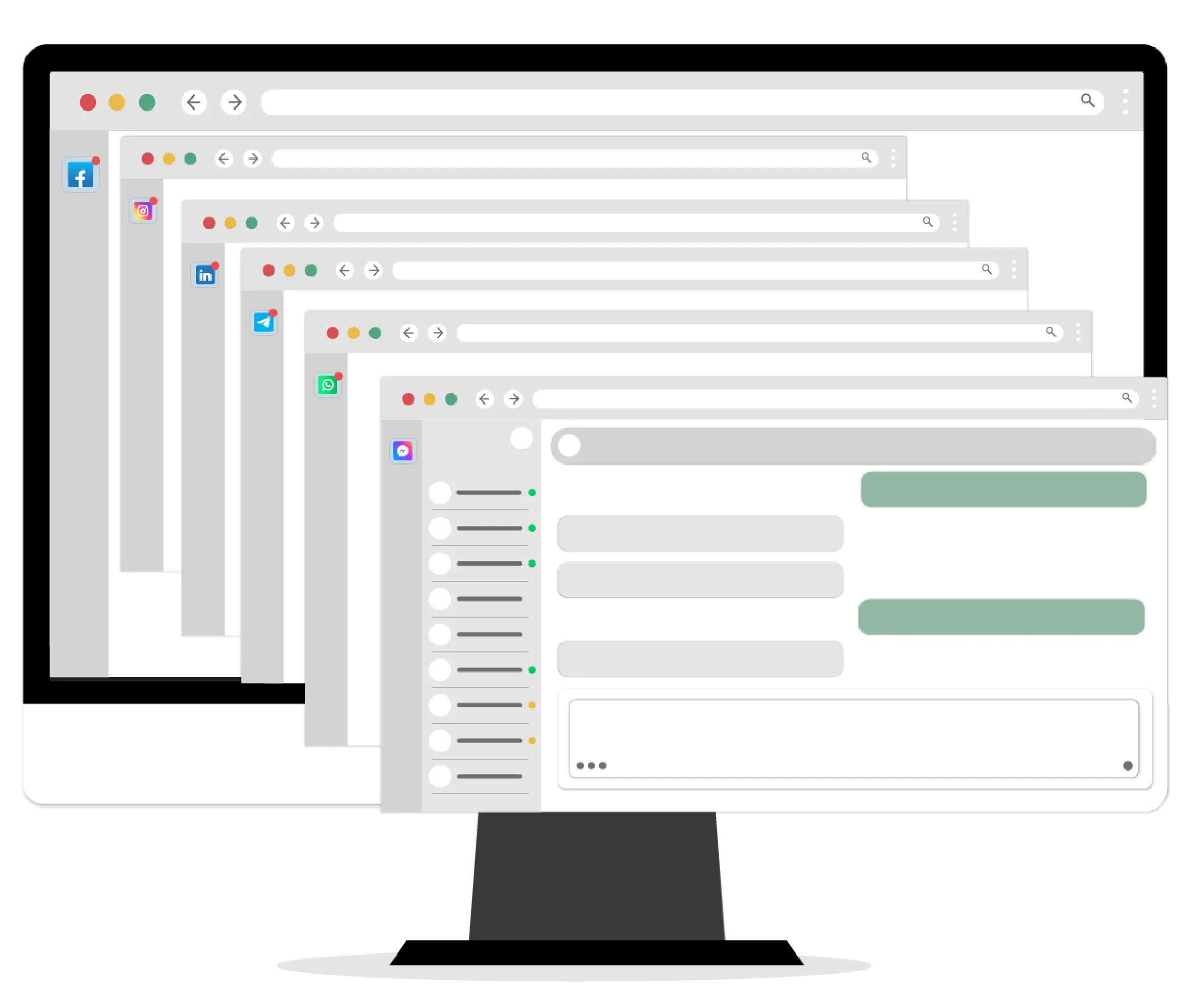
The typical silos in a non-integrated contact center are almost always the same: tickets on one management system, chat on another tool, calls on the PBX, social on a third platform. Every system has its own login, its own data, and its own queues, and none of them offers a unified view.
The operational consequences are measurable: longer response times, SLAs (Service Level Agreements, the agreed-upon service standards) that are hard to meet, duplicated information, context lost when moving from one channel to another, overloaded operators. On the business side, this translates into lower customer satisfaction, higher operating costs, and lost commercial opportunities, whenever a request goes unanswered on an unmonitored channel. The Omnichannel Customer Experience Observatory at Politecnico di Milano itself frames omnichannel customer care as moving beyond the traditional “siloed” management of support — a sign that, for many organizations, that fragmentation remains the starting point rather than the destination.
Why the silo problem gets worse as you add more channels
The mechanism is counterintuitive: every channel added without integration doesn’t reduce complexity — it multiplies it. Activating an Instagram profile or a WhatsApp number when the other channels are already disconnected just adds another window to monitor, another login, another invisible queue. Part of the problem is structural: many social channels are natively kept separate (Facebook, Instagram, and WhatsApp) with no single access point, no layer that unifies them; more channels produce more fragmentation, not more service.
The four channels to unify: ticketing, chat, voice, and social
Each of the four channels named in the title brings value, but creates a specific problem when managed in isolation.
- Ticketing and email: an asynchronous channel where the risk is invisible queues and SLAs that are hard to monitor without a unified system giving an overview of what’s open and how long it’s been waiting.
- Chat (webchat and WhatsApp): a synchronous or semi-synchronous channel where context is easily lost if the customer comes back hours later, perhaps from a different device, and finds an operator who doesn’t know about the previous conversation.
- Voice (phone / VoIP): the channel with the highest perceived priority, callers expect an immediate answer and often have an urgent need, yet paradoxically the one most often isolated from the rest of the digital flow; here, CRM integration is critical.
- Social (Facebook, Instagram, Telegram): growing volumes and expectations of a quick response; without centralization, the risk is responding inconsistently or too late.
There’s only one principle holding it all together: every channel needs to share the same conversation history, the same queues, and the same metrics. It’s this sharing, not the number of channels, that sets an omnichannel contact center apart from a collection of separate inboxes.
Voice and digital: why VoIP-omnichannel integration is the most critical step
Bringing voice into the omnichannel flow is the most delicate integration, for two reasons. Voice is the most urgent channel: callers expect an immediate answer, with no room for delay. And it’s also the one most often kept separate from digital, because it traditionally lives on the PBX rather than alongside the rest of the systems.
The difference between native integration and middleware (a generic system placed between two pieces of software) is concrete. When the same vendor develops and manages both the VoIP PBX and the platform, it’s possible to control the entire line and enable functions that an external connector can’t, for example, carrying the caller’s number all the way through to the system even after several transfers, so the customer is recognized right away. Third-party middleware placed in the voice flow breaks that chain. That’s the technical reason why VoIP-omnichannel integration is the prerequisite for unification, not just a minor detail.
How a silo-free omnichannel architecture works
In operational terms, an architecture that eliminates silos can be represented as a stack of layers: at the top are the channels through which requests enter, and at the base are the business systems that store and enrich the data. The diagram below summarizes the main building blocks and how they communicate with each other.
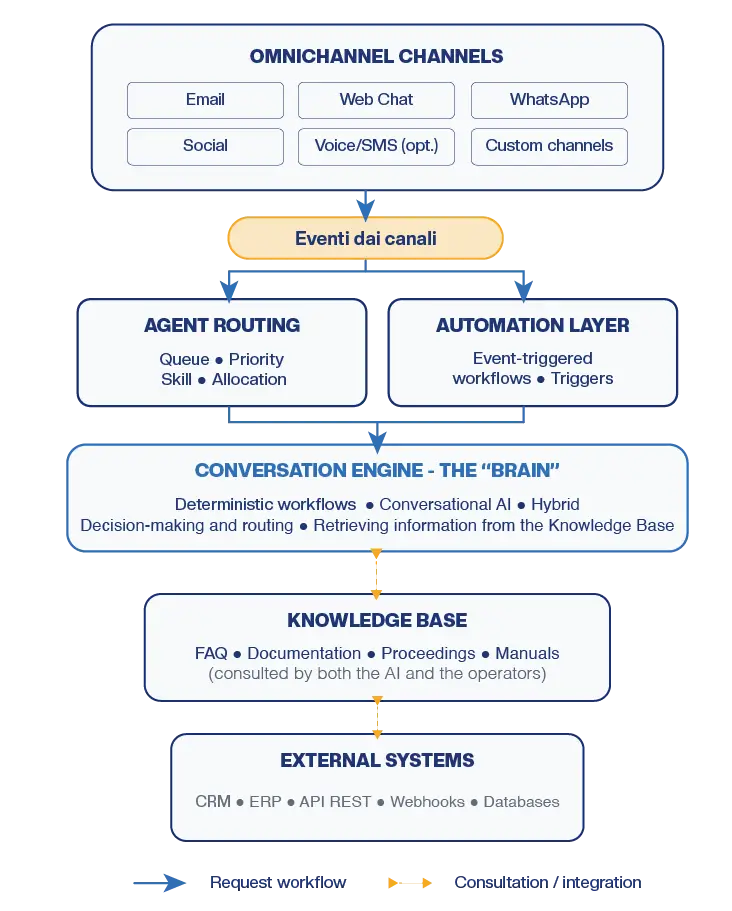
The layers are as follows:
- Channels (the entry layer): the first step is choosing which channels to activate, typically email, webchat, WhatsApp, and one social channel, leaving out the marginal ones. This is where interactions come in from.
- Events and automation layer: every incoming interaction generates an event, and at this point a choice comes into play: route the request straight to the operator queue, or insert a layer of automated flows that trigger on the event (an email arriving, a WhatsApp message) and handle recurring requests autonomously.
- Conversation engine, the “brain”: this is the layer that carries the dialogue forward and makes decisions. It can be fully deterministic (predefined flows and rules), entirely AI-based, or hybrid, the most common setup today. This is also where it’s decided whether and when the conversation should be handed off to an operator.
- Routing to agents: when human intervention is needed, the conversation is routed to the right operator by managing queues, priority, skills, SLAs, department, or language, regardless of the originating channel.
- Knowledge base: a centralized repository of company knowledge (FAQs, documentation, procedures, manuals) accessible to both AI models and operators; whenever information is needed, it’s retrieved from here.
- External integrations: at the top layer, the platform communicates with the rest of the company’s systems (CRM, ERP, database) via APIs and webhooks. This is the layer that makes it possible to recognize the customer and retrieve their data while the conversation is still in progress.
One element in particular turns this structure from “many channels” into “a single experience”: the unified conversation thread. Every customer has a single record, effectively a ticket tied to the contact, into which the history from all channels flows. Context is preserved because contacts are recognized and merged: if a contact has both a phone number and an email on file, interactions arriving through those identifiers flow into the same thread; even a chat conversation links up with the rest as soon as the flow captures an identifying piece of data, like an email address. When the “brain” decides to escalate, the operator receives the conversation along with the entire history already gathered, with nothing for the customer to repeat.
A concrete case is a project for a car rental company with multiple branches: an old responder that simply collected information and transferred calls was replaced with an integrated flow. From the caller’s number, the system recognizes whether it’s an existing customer, retrieves their data during the conversation, and, once the vehicle is identified, opens a report to the relevant branch or routes the call to the right department. Defined once on the voice channel, the same flow is then replicated on web and WhatsApp: that’s what it means to unify channels around a process, not a single tool.
Which technologies enable real omnichannel: crm, cdp, and conversational platforms
The tools that make this model possible fall into a handful of categories. The CRM is the foundation: it collects and transmits customer information, which is why integration with the leading CRMs is a requirement, not an optional extra. The Customer Data Platform (CDP) unifies data from different sources into a single, coherent customer profile. Conversational platforms and CCaaS (Contact Center as a Service) systems provide the operational layer: queues, routing, agents, dashboards. Security at this layer isn’t a secondary concern, since it concentrates every customer’s data in a single place: handling it within a certified environment, ISO 27001, for instance, becomes part of the architecture itself, not a separate compliance exercise.
Concrete benefits of silo-free omnichannel: what changes for operators, managers, and the business
The value of an omnichannel customer experience shows up at three levels.
- For operators: less context-switching between applications, less time spent on repetitive tasks, more focus on high-value requests. A practical detail that matters: with the right automations in place, support operators don’t get sales requests, and vice versa.
- For managers: real-time visibility into KPIs (response times, workload by channel, agent performance), and therefore the ability to optimize SLAs and resources based on real data.
- For the business: lower operating costs thanks to automating repetitive flows, rising CSAT, a consistent experience across every touchpoint, and, above all, no message left behind.
What's an example of an omnichannel goal?
A well-defined omnichannel goal is measurable. One example is reducing AHT (Average Handle Time) by 25-30% by centralizing chat, email, and phone on a single dashboard, with shared history and automatic routing. The savings come from one specific point: the operator no longer spends time gathering information that’s already available on another channel. There are just a few concrete metrics worth tracking: First Response Time (FRT), AHT (Average Handle Time), CSAT (Customer Satisfaction Score), First Contact Resolution (FCR), and the share of requests handled by automation versus those handled by a human operator.
The real challenges in eliminating silos: what gets in the way of adoption
An honest analysis includes the obstacles, which are often not technological. The first is organizational: in many companies, channels belong to different departments (marketing runs social, customer care runs the phone, IT runs ticketing) with no shared ownership of the customer experience. As long as each department defends its own silo, no platform will truly eliminate it.
The second obstacle is IT integration: connecting the CRM, VoIP PBX, ticketing systems, and new channels requires carefully considered architectural choices.
The third is change management: operators need to adopt new workflows, and training matters just as much as the technology. A recurring mistake in new projects has more to do with AI agents than with omnichannel itself: feeding the knowledge base with unvetted documents leads the bot to give confused or overly generic answers, so the knowledge base needs to be carefully curated.
Finally, there’s the investment: the return is measured over time, so it’s worth identifying quick wins, like eliminating duplicate tickets, alongside the longer-term benefits. Based on VoiSmart’s experience across more than 1,200 clients spanning businesses and public administration, the projects that start from the organization rather than the technology are the ones that stick over time.

Where to start: A practical approach to unifying channels
You don’t need to unify everything at once. A realistic path toward a scalable omnichannel platform breaks down into five steps.
- Map channels and silos: an audit of interactions by channel and identification of the breaking points in the customer journey, where customers repeat information, where context gets lost.
- Define the target conversation thread: establish what needs to “follow” the customer from one channel to another, history, open tickets, CRM data.
- Choose the platform and core integrations: check compatibility with the existing CRM and VoIP PBX as a priority, it’s the technical prerequisite that unlocks real unification.
- Automate repetitive flows: chatbots and AI agents for first contact, automatic routing, escalation that carries context to the operator.
- Measure and iterate: set baseline KPIs (FRT, CSAT, FCR) and proceed through optimization cycles.
As for the order of channels, experience suggests starting with the ones that are easiest to configure (webchat, then email and WhatsApp) leaving voice for last, since it’s the most delicate. This way, the first results become visible quickly, while the more complex integration is tackled once the system is already up and running. To dig deeper into how these principles translate into a complete platform, the dedicated guide to omnichannel communication offers a fuller picture.
Frequently Asked Questions (FAQ)
We have compiled the answers to our users’ most frequently asked questions here.
What does omnichannel mean?
It's an approach to managing business communications that integrates every contact channel (voice, chat, email, social, ticketing) into a single, coordinated experience. Unlike multichannel, it doesn't just make more channels available: it ensures the customer's context (history, requests, data) is shared across every touchpoint, removing the need to repeat the same information at every interaction.
What's the difference between multichannel and omnichannel?
Multichannel provides several channels that are separate from one another; omnichannel integrates them. A customer can start a request via chat and continue it by phone without repeating anything, because the operator accesses the same conversation history. The difference isn't in the number of channels, but in the consistency of the experience from one to the next.
What's an example of an omnichannel goal?
Reducing Average Handle Time by 25-30% by centralizing the management of chat, email, and calls on a single dashboard, with shared history and automatic routing. The measurable result is less time spent gathering information that's already available on other channels.
What's a synonym for omnichannel?
In business and technology contexts, common terms include: omnichannel (the standard English term), integrated multichannel communication, and unified customer experience. In software platform contexts, people also talk about an omnichannel contact center or a unified communication platform.
Ultimately, omnichannel isn’t measured by the number of active channels, but by the number of times a customer didn’t have to repeat their information. Eliminating silos is, first and foremost, an organizational decision about how people work and how data flows, one that technology then makes possible. And that’s the premise worth starting from.