
The question “chatbot or voicebot?” often hides a framing mistake: it’s not about choosing the most advanced technology, but the one that meets your users on the channel they already use. A brilliant voicebot is useless if your customers write to you on WhatsApp; a perfect chatbot is no help to someone who picks up the phone because they want an answer right now. After more than twenty years spent connecting conversational AI to company PBXs, at VoiSmart we’ve learned that the right choice always starts there: with the real behavior of the people who will use the system. In this guide, we compare chatbots and voicebots with a decision table covering seven typical operational scenarios, along with the limitations that are rarely talked about.
Chatbot and Voicebot: two different tools, one same goal
Chatbots and voicebots have more in common than it might seem. Both automate a natural-language conversation using the same AI engine; what changes is the channel through which that conversation takes place. This is where the real difference between chatbot and voicebot lies, and every sensible decision starts from this point.
What's the difference between a Voicebot and a Chatbot?
A chatbot AI handles text-based interactions such as webchat, WhatsApp, social media, and email, typically asynchronously: users write whenever they want and can also attach images, documents, or links.
A voicebot AI behaves like a phone operator: it answers the call within the PBX platform and talks with the caller by voice, just as a human operator would. Under the hood, the conversational engine is the same; the voice channel simply adds one extra step. Put simply: chatbot vs. voicebot is a difference of channel, not of intelligence.
What is a Voicebot?
A voicebot is a conversational AI system that understands spoken language and responds by voice. Unlike the old menu-based responder, it doesn’t force users to choose between preset options: it understands a full sentence and acts on it accordingly. Technically, this involves two components the chatbot doesn’t have: ASR (Automatic Speech Recognition, which transcribes speech into text) and TTS (Text-to-Speech, which turns the response into voice). The “brain” in between, on the other hand, uses the same technologies as the chatbot: NLP (Natural Language Processing), NLU (Natural Language Understanding, i.e., intent comprehension), and modern LLMs (Large Language Models).
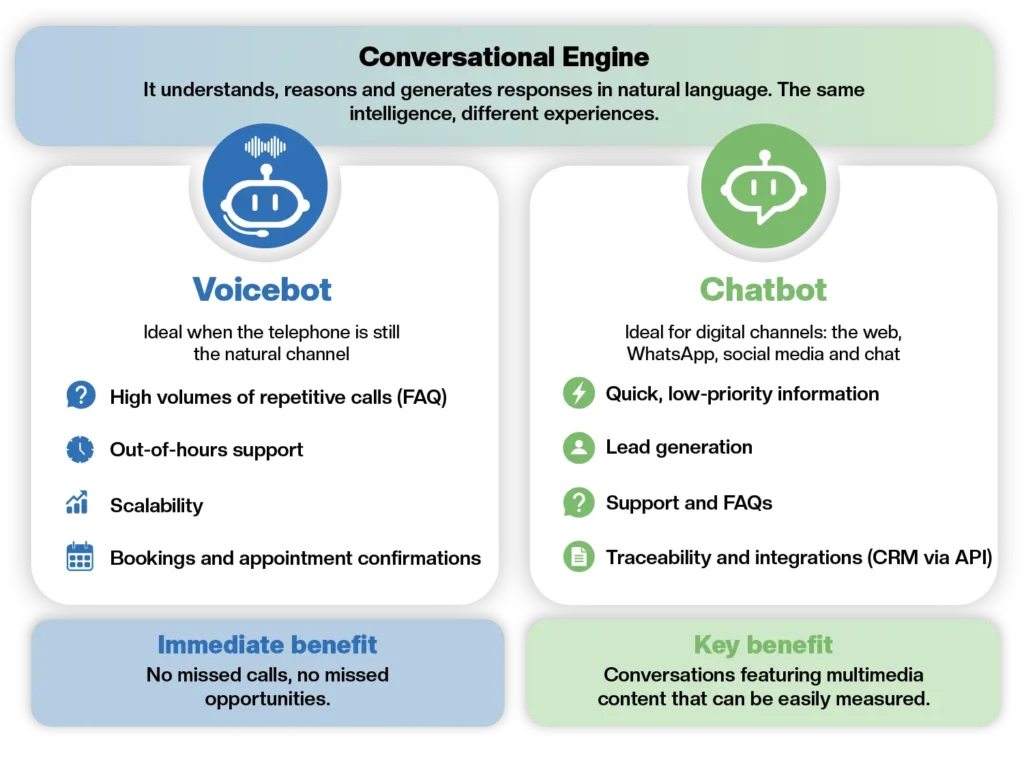
A voicebot performs best when the phone is still the natural channel for a company’s users. This happens more often than IT teams might expect: in public administration, in healthcare, among less digitally savvy users, and in every context where callers see the phone as a synchronous channel: “I have a problem right now, and I want an answer right now.” Based on VoiSmart’s experience, businesses running traditional support services and those working in B2B still find the phone call to be the go-to tool for urgent matters.
Cases where an AI voicebot delivers measurable value in customer service:
- High volumes of repetitive calls: according to the VoiSmart technical team, nearly all requests to a support center are questions that an FAQ can answer (hours, the status of a request, standard information). Tying up an operator to repeat the same answers over and over is time taken away from higher-value work.
- After-hours support: the operator clocks off at 6pm, but a customer who finishes work at 6:30pm still needs to be able to reach support: the voicebot answers, collects the request, and, where needed, triggers a callback service.
- Bookings and appointment confirmations, handled autonomously, with calendar integration.
- Scalability without increasing contact center headcount.
There’s also a benefit customers tend to notice almost immediately, and one they often hadn’t factored in: people whose work can’t be interrupted (technicians, tradespeople, professionals) stop missing calls that used to go unanswered. Every missed call is a missed opportunity, and the bot can catch it for them.
Conversational IVR vs. Voicebot: what's the difference?
The traditional IVR is the touch-tone menu we all know: “press 1 for support, press 2 for administration.” It routes calls, but users often don’t know where they’ll end up and hang up. Conversational IVR flips that logic: instead of making users navigate a decision tree, it asks what they need and interprets the answer in natural language. The voicebot is the evolution of this approach. The most common mistake is rebuilding the old IVR in disguise: “are you a customer or a supplier? Press 1…”, because those questions make sense to the company, not to the user, who often doesn’t know exactly what they’re looking for in corporate jargon. The right approach is the opposite: the voicebot introduces itself (“we’re company X, we do Y”), asks what the caller needs, and routes the call accordingly.
When to choose the voicebot: strengths and ideal use cases
An AI chatbot is the natural choice when the interaction lives on digital channels: website, WhatsApp, webchat, social media. Its advantage isn’t just convenience, but the type of relationship it enables. Chat is often the channel for first contact, quick information, and marketing, since it gives visibility, engages the visitor, and qualifies interest without forcing anyone to pick up the phone.
Where the chatbot excels:
- Quick, low-urgency information: to check business hours or an order status, many users, especially younger ones, prefer to type rather than stop what they’re doing, look up a phone number, navigate an IVR, and wait on hold. Chat is asynchronous and lets people respond whenever they can.
- Lead generation: here, the chatbot works well as a data-collection tool. In practice, sales reps don’t want the bot to draw up a quote for them; they want it to gather a couple of useful pieces of information while they’re busy or off the clock, and have them ready for a targeted callback the next day.
- Support: after-sales support, onboarding, and text-based FAQs on monitored channels.
- Traceability: every conversation is a structured log, far easier to analyze and integrate into the CRM via API than a phone call.
- Brand consistency: the webchat widget can be customized to match the site’s visual identity.
On the technical side, a modern NLP-based chatbot has nothing to do with the old “button-based” bots: it understands language, doesn’t force users to pick from a touch-tone menu, and can do things the voice channel can’t, like sending images, documents, and links to enrich the response with multimedia content.
When to choose the chatbot: strengths and ideal use cases
Decision table - 7 typical scenarios compared
The guiding criterion is always the same: what is the prevailing channel for end users in that specific scenario? The table doesn’t replace an analysis of the context, but it offers a solid starting point for choosing between chatbot and voicebot.
Appointment management, for example, works great for the standard case (a car inspection, a tire change, a check-up visit) where you know which day has availability for that service: the bot books the appointment in the calendar and it’s done. But when an off-script request comes in, like “my car broke down, what do I do?”, the voicebot shouldn’t improvise, it hands off to a human operator. This is the principle that applies to every scenario: the bot handles the predictable, the human steps in for the exception, and in reality, many of these scenarios don’t fit neatly into a single row.
| Scenario | Prevailing channel | Tool | Key reason |
|---|---|---|---|
|
➊ Appointment management (healthcare, public administration) |
Phone |
Voicebot |
High share of non-digital users; calendar integration for standard cases |
|
➋ 24/7 customer care for e-commerce |
Web / App |
Chatbot |
Native digital channel; every conversation is a log ready for the CRM |
|
➌ Lead generation from the website |
Web |
Chatbot |
Captures data in text form; immediate CRM integration |
|
➍ PA front office (virtual service desk) |
Phone + Web |
Both |
Dual channel for maximum inclusivity |
|
➎ Internal HR/IT helpdesk support |
Web / App |
Chatbot |
Controlled context, users already used to digital tools |
|
➏ Reminders and confirmations for existing customers |
Phone / SMS |
Voicebot |
Proactive confirmation of already-booked appointments, no app required |
|
➐ Support in physical locations (retail, airports) |
Web / QR / App |
Chatbot |
Integrates with on-site digital touchpoints |
Chatbot + Voicebot together: when an omnichannel approach is the answer
Often the question “chatbot or voicebot?” is the wrong one to ask, because the real answer is “both, working together.” An AI virtual assistant becomes truly useful when the context of the conversation isn’t lost as it moves from one channel to another: the user starts on WhatsApp and finishes on the phone, or vice versa, picking up right where the same “memory” left off. This is the logic behind the modern contact center: a single view of the customer across different channels.
When choosing is pointless: cases where you need both
Some concrete examples of dual-channel scenarios:
- a public administration body with both a physical service desk and digital services, which needs to stay inclusive toward people who don’t use the web;
- a bank with both an app and a call center;
- a company with a mixed customer base of B2B clients (who call) and B2C clients (who write).
A real case from the VoiSmart projects that illustrates this well is a car rental company with multiple locations across the country, all reachable through a single number, with one person answering and transferring calls. It moved to automated call routing and started handling situations that simply didn’t exist before, like answering calls outside business hours and on weekends. An AI agent collects the request and decides whether to trigger on-call support, for emergencies, or simply log it in the CRM, leaving it to operators to call the customer back.
The same engine can later be extended to a text channel: if a company currently works only over the phone, activating WhatsApp is one more way for customers to reach it, without having to start from scratch.
At VoiSmart, VoiceBot AI and ChatBot AI are both part of the OmniCloudCX platform and share the same conversational engine. The VoiceBot integrates natively with the Orchestra PBX and also works with third-party PBXs. The specialized-agent architecture, transcription with an analytics dashboard, and GDPR-compliant design all stem from the real-world constraints of regulated clients like public administration and healthcare.
ROI and costs: what changes between Chatbot and Voicebot
Before even talking about costs, it’s worth setting the indicators. Without a stated objective, there’s no measurable ROI: if the goal is support, you look at how many conversations the bot resolves on its own versus how many it hands off to a human operator; if the goal is commercial, you measure how many conversations end up producing a qualified lead.
The most commonly used metrics for a voicebot in a contact center and for an AI chatbot:
- FCR (First Contact Resolution): the share of requests resolved on the first contact.
- Deflection rate: the share of requests handled by automation without going through an operator.
- AHT (Average Handling Time): the average time to handle a request.
- CSAT / NPS: the satisfaction users report.
On the cost side, the main line items are initial development and setup, integration with existing systems, and model maintenance and updates. In general, a voicebot has a heavier infrastructure component (speech recognition and synthesis, phone integration), but it delivers value quickly in high-call-volume scenarios. A chatbot typically starts from a lighter entry point, with a measurable return in reduced tickets and better contact qualification. The number that actually matters is the one that comes out of each business’s own scenario.
Technological limitations not to underestimate
An honest comparison includes the limitations: the first one, which applies to both, is about expectations, the bot doesn’t do everything. What it hasn’t been taught, the bot doesn’t make up on its own, or rather, if left unconstrained, it tends to make it up (the so-called “hallucinations”), and that’s exactly what needs to be avoided. The more context and instructions you give a single AI agent, the more it loses alignment and stops following the rules. That’s why it’s not advisable to hand everything to one agent; instead, use specialized agents that pass the conversation to one another step by step, each with a defined scope and access only to the resources it actually needs. That’s how you keep behavior under control.
For the voicebot, the critical point is speech recognition. Understanding a user’s intent doesn’t take much, since context helps. Precision matters, though, when dictating data like tax codes, phone numbers, or license plates, and here LLMs have improved things a lot over the past few years: the voicebot repeats back what it understood and asks for confirmation, the same way we do when we spell something out letter by letter over the phone.
The real enemy remains background noise, especially when it’s speech: multiple voices in a room, combined with a device that lacks noise cancellation, make things difficult for the system, which struggles to distinguish the speaker from the surrounding sound.
For the chatbot, two practical limitations:
- Accessibility: for some users, writing and reading in a chat window can be a genuine obstacle.
- Privacy, and this isn’t just theoretical: relying on WhatsApp means stepping outside the European perimeter and giving up end-to-end encryption for that flow. In contexts where sensitive data is involved, think of a medical clinic, this is something to weigh carefully when deciding how to set up the channel.
What is a Voicebot service?
“Voicebot service” refers to the combination of technology and configuration that lets a company automate its phone interactions: the AI engine, integration with company systems (CRM, calendar, database), and flows designed for specific scenarios. Increasingly, this also includes an analytics layer: conversations can be transcribed in compliance with GDPR, with proper notice and data deletion, and enriched with metrics like duration, number of messages, and call outcome. From a dashboard, you can see recent conversations, and a configurable panel shows distribution, duration, and outcomes; you can even define “tags” that the AI uses to automatically label conversations, useful for understanding what users are really asking about or for basic sentiment analysis. The limitation to keep in mind is one of expectations: a well-built voicebot service also knows when to stop and hand off to a human operator.
Frequently Asked Questions (FAQ)
We have compiled the answers to our users’ most frequently asked questions here.
What's the difference between a Voicebot and a Chatbot?
The voicebot interacts by voice: it receives audio, converts it to text (ASR), processes the response with AI, and returns it as synthesized speech (TTS). The chatbot operates in text form on a website, app, or messaging platform. The difference is the channel, voice versus text, since the underlying conversational engine is the same.
What is a Voicebot?
It's a conversational AI system that handles voice interactions in natural language. As an evolution of the traditional IVR, it doesn't require selecting options from a menu: it understands full sentences and responds contextually. It's typically integrated into the PBX or contact center.
What is a Voicebot service?
It's the combination of technology and configuration that automates phone interactions: the AI engine, integration with company systems (CRM, calendar, database), and flows designed for scenarios like bookings, FAQs, or support. It increasingly includes conversation transcription and analysis, plus the ability to hand the call off to an operator when the request falls outside its scope.
What's the best AI Chatbot?
There's no universal answer: it depends on the use case, the distribution channel, the integrations required, and the budget. It's worth evaluating the quality of the NLU, how easily it integrates with existing systems, the customization options, and the technical support available on the Italian market.
The right question, then, isn’t “chatbot or voicebot?” but “where are my users, and what do they expect when they reach out to us?” Answering that almost always clears the way to an obvious choice, and quite often to an architecture where the two tools work together. Everything else is design: defining the objectives, mapping the flows to people’s real behavior, and keeping the knowledge base up to date, so the system stays useful over time.