The evolution of Customer Experience increasingly hinges on managing the voice channel, a touchpoint that remains essential for both users and citizens. Anyone responsible for a company’s IT infrastructure or customer care operations today faces a complex challenge: reducing operational overload on their departments without compromising service quality.
Adopting a voicebot connected to the PBX is therefore the most efficient response to this need, provided you understand the real scope and the actual implementation timelines of this conversational technology within business processes.
What it means for a Voicebot to be connected to the PBX, and why it's different from an IVR
To understand the value of an advanced virtual assistant, it’s necessary to draw a clear line between it and traditional systems.
Legacy automated responders, known as IVR (Interactive Voice Response) systems, rely on fixed-option phone menus, along the lines of “press 1 for administration, press 2 for support.” This rigid approach forces users down standardized paths, lengthening wait times and increasing call abandonment rates due to the frustration caused by complex menus.
A voicebot integrated with the company PBX flips this paradigm by leveraging Natural Language Processing (NLP) technology. Users no longer need to interact by keying in numbers on their phone; instead, they simply speak their request freely: the system analyzes the intent behind the sentence, understands the context, and formulates the appropriate response in real time.
From an IT architecture standpoint, a voice assistant for the phone system fits directly into the inbound call flow without requiring any replacement of the existing infrastructure. Thanks to native compatibility with the SIP protocol, the conversational assistant becomes a logical extension of the company PBX, not a separate or parallel system.
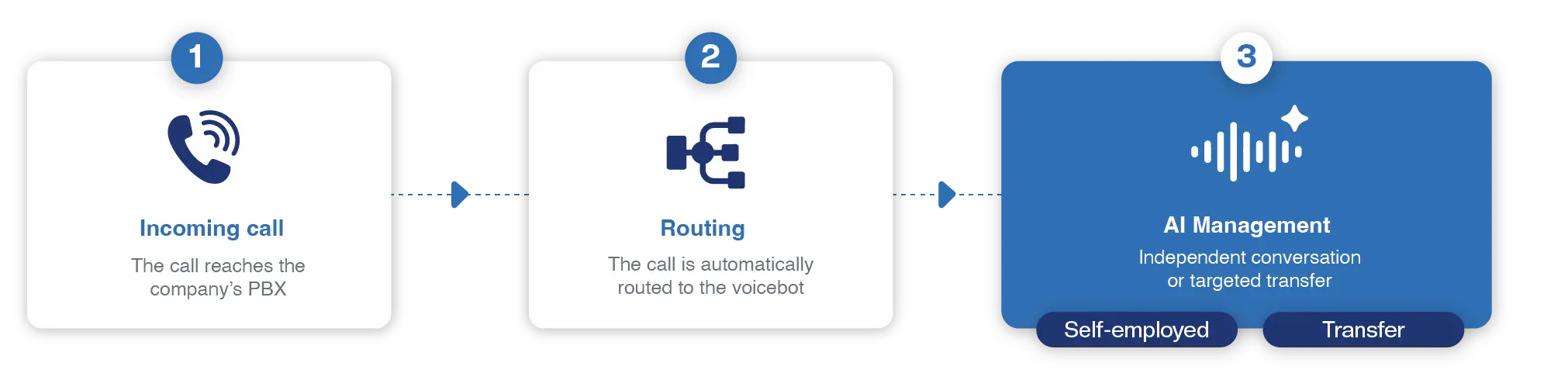
The mechanism works along a straightforward path:
- The inbound call reaches the company PBX.
- The infrastructure routes the call directly to the voicebot for initial handling.
- The AI system manages the conversation autonomously, or, based on the needs expressed by the caller, transfers the line to the appropriate destination.
The automations you can activate within 30 days
Bringing artificial intelligence into business workflows doesn’t require months of development or complex configuration when it comes to a voicebot connected to the PBX.
By taking a modular, step-by-step approach, specific tasks can be delegated to the virtual assistant as early as the first few weeks, delivering a measurable impact on day-to-day workload.
During the roll-out phases, the focus is on first-level automations, characterized by quick configuration times and an immediate impact on high-volume, repetitive calls:
- Answering phone FAQs: an automated PBX with voice response capabilities can independently handle all standardized informational requests, such as sharing opening hours, company addresses, return instructions, or order status updates. The voicebot responds instantly, freeing up staff from low-value tasks;
- Personalized 24/7 greetings: the platform ensures constant coverage of the phone channel, managing tailored, structured welcome messages even outside official business hours or on holidays;
- AI-based call routing: the system routes calls using AI, directing the contact to the right department without forcing the user through human filters or unnecessary wait times;
In a second phase, the features involve secure interaction with company databases:
- Bookings and appointments: integrating automated bookings between the PBX and company calendars makes it possible to check remaining availability in real time, schedule the session requested by the caller, and send an instant confirmation message via SMS or advanced messaging channels like WhatsApp.
- Data collection and lead generation: during the voice interaction, the system structures the collection of personal details, contact numbers, and reasons for the request, then transfers this information directly into internal systems.
How the Voicebot integrated with the PBX works
The architecture of an advanced PBX that leverages voicebots is designed to ensure maximum fluidity for both external users and the company’s internal organization. End-to-end flow stability is an essential requirement here for preserving continuity of phone service.
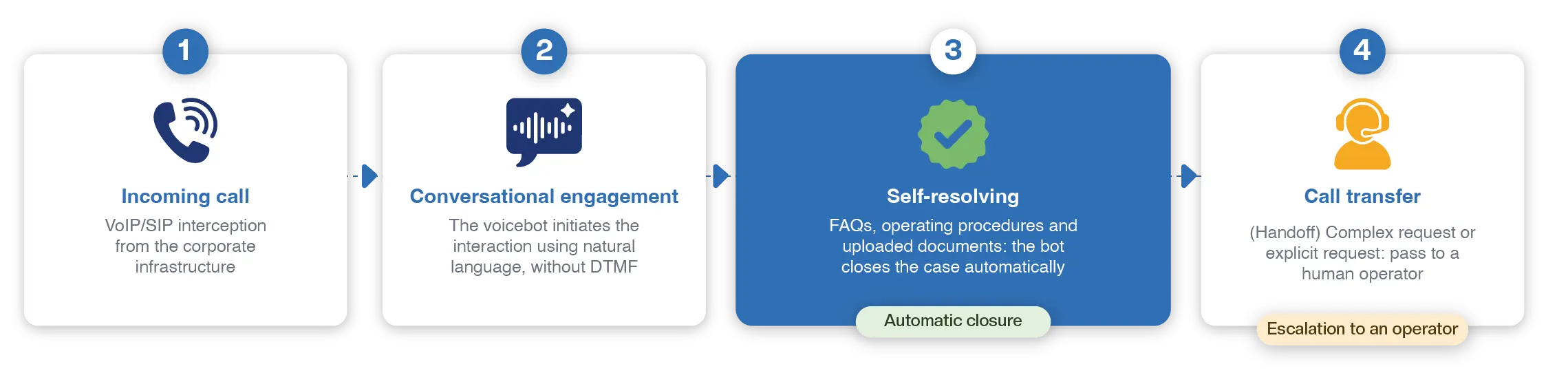
A call’s journey unfolds as follows:
- Call entry: the call is intercepted by the company’s VoIP/SIP infrastructure.
- Conversational engagement: the voicebot takes over the session, initiating natural-language interaction with no need for dual-tone multi-frequency (DTMF) signals.
- Autonomous resolution: if the question falls within the scope of the FAQs, the configured operational procedures (such as appointment scheduling), or the uploaded documents, the bot completes the operation entirely on its own.
- Assisted transfer (Handoff): if the request’s complexity exceeds the configured operational capabilities, or if the user explicitly asks to speak with a staff member, the call is transferred to a human operator.
Integration with CRM, calendar, and business systems
The value of integrating a voicebot into a VoIP environment lies in its ability to communicate with the software ecosystem already in place within the organization. A voice assistant isolated from company data would, in fact, have limited problem-solving capabilities.
The flexibility of API interfaces allows a platform like OmniCloudCX to connect securely to the leading management software and CRMs on the market. When a customer calls for support, the system can query the database in real time, recognize the phone number linked to their record, and personalize the response experience based on the user’s commercial or technical history.
Automatic synchronization then turns every single call into a business or efficiency opportunity: personal data extracted from speech is entered into customer records, reducing manual transcription errors and ensuring company information systems stay constantly up to date. In booking procedures, for example, two-way communication with calendars prevents overbooking issues, while also automating reminder messages to reduce no-show rates.
Reducing operational workload: the numbers that matter
Introducing a virtual PBX must be backed by objective performance indicators (KPIs) capable of clearly demonstrating return on investment (ROI).
The main areas of impact are:
- Cutting down repetitive calls: delegating low-complexity tasks reduces the share of phone traffic handled manually by operators, who can then focus on complex cases requiring human sensitivity and expertise.
- Eliminating wait times: the voicebot answers every incoming call instantly, eliminating phone queues and improving how users perceive the service.
- Recovering after-hours calls: round-the-clock operation makes it possible to capture and handle contacts that would otherwise be lost, logging requests even at night or on weekends.
A system like OmniCloudCX comes with a native dashboard that lets managers monitor useful data in real time, from the total conversation minutes handled by AI, to the volume of calls successfully completed without human intervention, to the number of follow-up notifications sent via SMS or WhatsApp.
Since a voicebot’s effectiveness scales with the volume of inbound calls that show low variability, configuration costs are recovered quickly in settings with intense, recurring call flows.
Voicebot for the PBX in high-volume sectors: use cases
The benefits of automating voice flows apply across multiple sectors that share the need to handle large volumes of standardized, everyday phone contacts: let’s look at some practical examples.
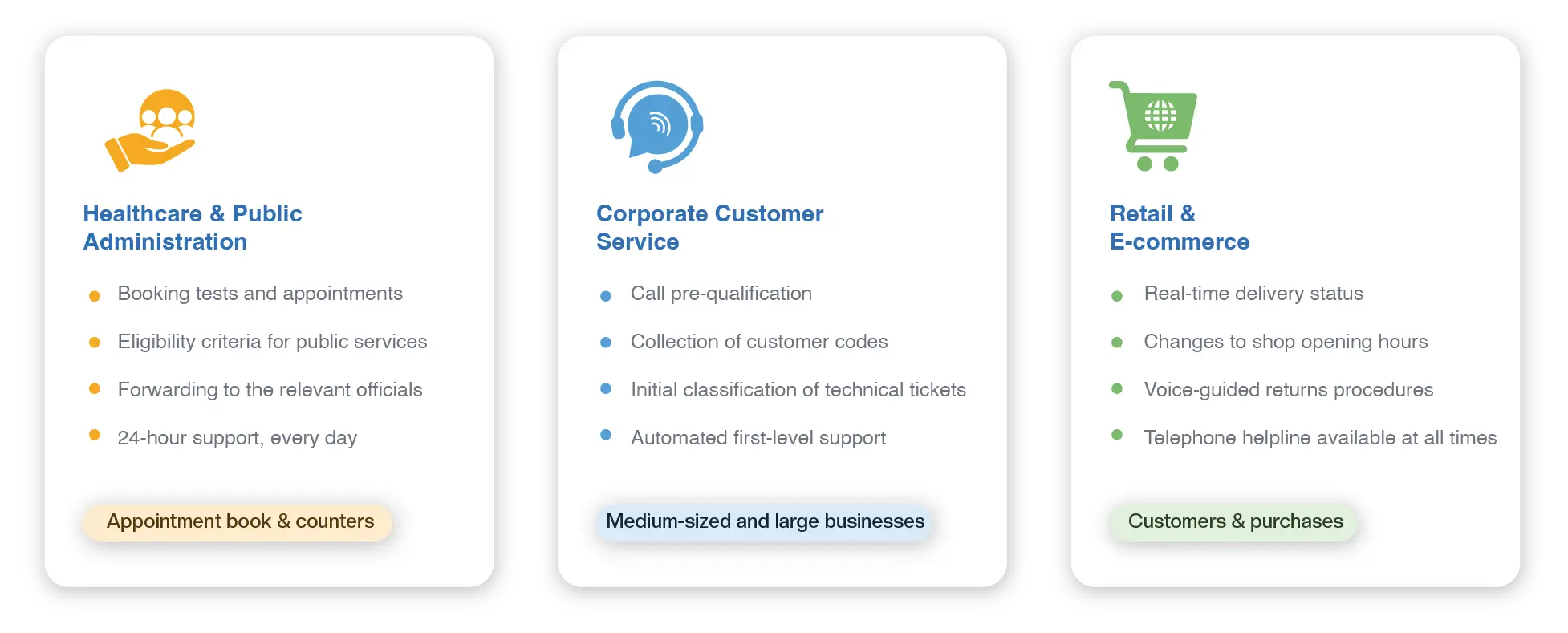
- Using a voicebot in healthcare facilities and public administration makes it possible to manage the complex scheduling of exams, medical visits, or appointments at municipal offices. The system collects citizens’ requests, provides quick answers about service access requirements, and routes more specific cases to the relevant officials, ensuring support for public services at any time of day.
- In medium and large companies focused on customer service, AI handles the first level of phone support, taking care of call pre-qualification, collecting customer codes, and performing initial classification of technical support tickets.
- In retail and e-commerce, the voice assistant is ideal for promptly informing customers about shipping status, communicating changes to physical store hours, and guiding users through standard return procedures, keeping the phone channel always active and responsive.
Voicebots in different sectors
Where voice automation delivers immediate value
Data Security and GDPR compliance in automated calls
Managing phone conversations through artificial intelligence involves processing sensitive personal information, such as personal details, phone numbers, and detailed reasons for the contact.
This is why every voice automation project must strictly adhere to GDPR compliance requirements for voicebots. This includes the mandatory provision of a personal data processing notice, delivered to the user in a concise and clear form at the start of the automated phone session, before any voice information is collected.
VoiSmart addresses these requirements by prioritizing data localization within the European Economic Area (EEA) wherever possible, and by operating under ISO 27001 certification for information security management. This international standard confirms the adoption of strict policies and rigorous controls to protect the integrity, confidentiality, and availability of the data handled by company platforms.
ISO 27001 compliance is therefore an essential element for implementing stable solutions within critical or sensitive infrastructures, such as those found in healthcare organizations, public administrations, and airport logistics hubs, ensuring that data synchronized with company CRMs is processed in full compliance with current regulations.
The VoiSmart voicebot solution is also classified as a limited-risk AI system under the AI Act. The AI Act categorizes artificial intelligence by risk level, and since the platform falls into the limited-risk category, it is compliant and subject solely to transparency obligations, meaning users must be informed that they are speaking with an AI at the start of the conversation.
Getting started: activating and configuring the voicebot on your PBX
Activating a platform like OmniCloudCX as an extension of the company’s communication infrastructure helps overcome the typical barriers to adopting AI-based technologies, avoiding the need to replace existing phone equipment that already supports SIP.
The onboarding process unfolds in a series of steps:
- Analysis of historical call flows and mapping of the most recurring intents among inbound calls.
- Configuration of welcome messages and development of the conversational tree for handling the main FAQs.
- Technical integration of the platform with the databases, CRMs, and calendars used by the organization.
- A controlled testing phase to verify the accuracy of the speech recognition systems and the stability of the handoff mechanism to operators.
Choosing to work with a solid technology partner gives companies constant support throughout every phase of the project. VoiSmart handles installation and support activities directly through its own in-house staff, eliminating intermediate steps and the complexities that come with external system integrators and intermediaries. This direct control over the technology speeds up activation procedures and allows monitoring functions to start immediately via the OmniCloudCX dashboard, making it possible to analyze the voicebot’s performance from day one of going live.
FAQ on Voicebots connected to the PBX
What is a voicebot service?
A voicebot service is virtual assistant software capable of holding conversations with human callers over the phone channel. Unlike traditional software, it uses artificial intelligence algorithms and natural language understanding to interpret users’ free-form voice requests, responding by voice or performing automatic actions on company systems without requiring users to press any keys on their phone.
How does a VoIP PBX integrated with a voicebot work?
The incoming call is received by the VoIP PBX, which routes it to the voicebot platform via the SIP protocol. The virtual assistant analyzes the caller’s speech, formulates the correct response, and, if necessary, interacts with the PBX to transfer the line to a human operator or the right department, while keeping the conversation’s context intact.
How long does it take to activate a voicebot on the PBX?
Native integration makes it possible to activate the first key automations, such as 24/7 greetings, intelligent call routing, and answers to company FAQs, within 30 days. More complex integrations with CRM systems or specific management software are introduced progressively in a second phase of the operational plan.
What happens when the voicebot doesn't understand a request?
If a user makes a request beyond the software’s configured capabilities, or if there are issues understanding the voice input, the platform initiates a secure handoff procedure. The call is transferred to an available human operator, who can be shown the data already collected so the user doesn’t have to repeat their request.
Is the voicebot compatible with my current PBX?
The OmniCloudCX voicebot is designed as a native extension and ensures maximum compatibility with all company phone infrastructures based on the standard SIP protocol. This means the PBX currently in use within the organization doesn’t need to be replaced, preserving the tools already installed.
Does the voicebot for the PBX also work for Public Administration?
Yes, the technology fully meets the needs of public sector organizations. VoiSmart already has direct trials underway with six major Public Institutions, including local health authorities (ASL), municipalities, provinces, and regions, covering roughly 150 IP phone lines to optimize the citizen experience and booking services.
Can the voicebot handle multiple calls at the same time?
Yes, unlike a human operator or a traditional phone line, the platform’s cloud architecture can simultaneously handle a large number of concurrent call flows. This scalability eliminates the problem of busy lines and completely removes wait times for users on hold.
Does the voicebot replace the receptionist, or work alongside them?
The voicebot isn’t designed to replace human staff, but to work alongside them within a collaborative operating model. By taking on the first level of contact and the bulk of repetitive or low-value calls, the virtual assistant frees up front-desk staff to focus on more complex reception and administrative tasks.
Do you have any more questions?
If you haven’t found the answer you were looking for here, our team is here to help. Please contact us for further information or personalised support: we’ll be happy to help you sort out any queries.